
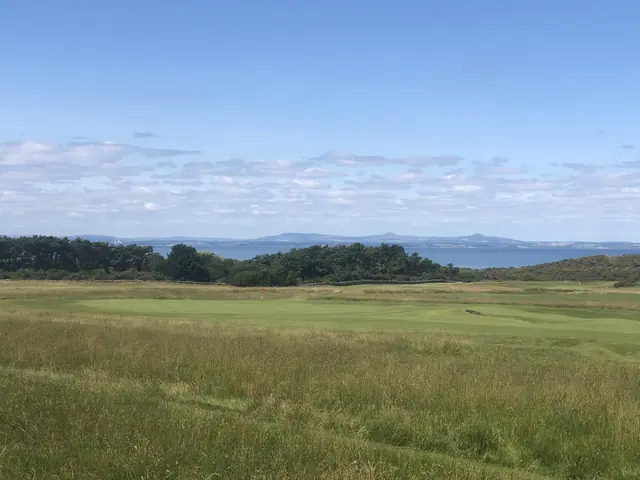

The story and its setting
Nick Faldo’s three Open victories offer three different versions of championship golf: a final round made entirely of pars, a five-stroke success on the Old Course, and a late recovery when a comfortable lead had almost disappeared. All three came in Scotland, at Muirfield in 1987 and 1992 and St Andrews in 1990. His wider career links those courses with eleven Ryder Cup appearances, four British PGA Championship wins and three Masters titles. Following that record reveals more than the familiar image of a relentlessly methodical major champion.
Faldo made his Open debut at Royal Birkdale in 1976, aged eighteen, and finished tied twenty-eighth. His final appearance came at St Andrews in 2015. Between those dates, the championship saw both the development of his game and its most successful years. The champions list records the winning editions; the places where he came close provide another important part of the story.
Success before the first major
Faldo was already an established winner before his first Open. His British PGA Championship titles came in 1978, 1980, 1981 and 1989. Those victories also chart the tournament’s changing geography: Royal Birkdale, Royal St George’s, Ganton and Wentworth respectively. The present-day association between the event and Wentworth should not be projected back onto all four wins. The PGA Championship history follows the earlier venues as well as its later Surrey home.
The names require care. This British PGA Championship, now the BMW PGA Championship, is separate from the PGA of America’s major. Faldo’s wins in it do not add four more majors to his career total. They do show that the player who later rebuilt his swing was not starting from an absence of success. His work with David Leadbetter during the two years before the 1987 Open involved changing an already competitive game in pursuit of a higher standard.
Muirfield 1987: eighteen pars
Faldo won his first major at Muirfield in 1987 with a total of 279. The distinctive part of the final round was its consistency: all eighteen holes were pars. That does not mean the round required eighteen easy approaches and routine two-putts. The official championship account records a demanding bunker recovery at the eighth, played close enough to preserve the sequence. When trouble arrived, the scorecard remained unchanged because he dealt with it.
Paul Azinger led after the second and third rounds and was three strokes ahead at the turn on Sunday. His advantage narrowed, but he remained one clear with two holes left. A bogey at the seventeenth brought him level as Faldo completed his own final par, and another bogey at the eighteenth handed Faldo the championship. Rodger Davis shared second place with Azinger, one stroke behind. The result therefore combined Faldo’s refusal to surrender ground with mistakes by a rival who had been in control.
It was a striking confirmation that the swing changes could hold up under major-championship pressure. It also gave Muirfield a modern winning story unlike Tom Watson’s birdie-filled final round there in 1980. The course had asked a different competitive question. Faldo’s answer was not a low final score but the ability to avoid adding the stroke that would have changed the result.
St Andrews 1990: making the advantage count
Faldo’s second Open came at St Andrews in 1990. He and Greg Norman were level at halfway after Norman opened with two rounds of 66 and Faldo returned 67 and 65. A close weekend duel seemed possible, but the third round changed the championship. Norman shot 76 while Faldo added another 67, moving into a five-stroke lead.
His 54-hole total of 199 was an Open record at the time. A final-round 71 completed 270 and an eighteen-under-par score. Payne Stewart and Mark McNulty finished five strokes behind. Those numbers need their historical framing: the achievement was a record when made, rather than an assertion that no later champion improved the scoring mark.
The final round was not completely free of competition. Stewart drew closer before trouble at the thirteenth ended his immediate challenge. Faldo moved clear again and reached the final fairway with a margin that allowed a very different finish from Muirfield in 1987. The two victories are often grouped under a reputation for control, but one had required waiting for another player’s last-hole mistake and the other had been built through a decisive Saturday performance.
Muirfield 1992: a lead almost lost
Faldo returned to Muirfield in 1992 and set a fast pace with rounds of 66 and 64. The halfway total of 130 was another Open record at the time. A third-round 69 brought him back to 199 and gave him a four-stroke lead. The figures suggested a repeat of his controlled St Andrews victory, but the closing day became a different contest.
As Faldo dropped shots, John Cook moved ahead. With four holes remaining, Faldo was two strokes behind. His approach at the fifteenth finished close enough for a birdie; he saved par at the sixteenth and birdied the seventeenth. Cook, meanwhile, failed to convert his opportunity at the seventeenth and bogeyed the last. Faldo needed a par at the eighteenth and made it, completing a closing 73 and a total of 272.
He won by one stroke. The contrast with his earlier Muirfield final round is particularly revealing: in 1987 he had protected par all the way; in 1992 he had needed late birdies after losing the position he had created. This was his third Claret Jug and fifth major. It also made him a two-time Open winner at Muirfield, alongside the earlier achievement of James Braid.
A lower score without the trophy
Faldo came close to a fourth Open at Royal St George’s in 1993. His rounds of 69, 63, 70 and 67 totalled 269, lower than the aggregate in any of his three victories. Greg Norman nevertheless won with 267 after a final-round 64. The comparison is a useful correction to judging a championship performance only by whether it produced the trophy. Faldo scored exceptionally well and was beaten by a player who scored better.
Sandwich consequently belongs to his history through both a PGA Championship win and an Open runner-up finish. It is a different connection from the repeated major successes at Muirfield. The course history places that 1993 contest among its other championships, while the Muirfield history follows the two contrasting victories.
The Masters half of the major record
Faldo’s other three majors were Masters titles in 1989, 1990 and 1996. The first two came through play-offs, against Scott Hoch and Raymond Floyd respectively. In 1996 he started the final round six strokes behind Norman but won by five, shooting 67 as Norman returned 78. That was Faldo’s sixth and final major title.
The American victories matter to understanding the Open years. By the time he won at St Andrews in 1990, he had already retained his Masters title. The British win was part of an established period of major success, not an isolated result. His later 1996 recovery also provides another competitive comparison with 1992: an apparently commanding advantage can disappear, and the pursuing player still has to produce the golf required to take it.
A Ryder Cup career across twenty years
Faldo played in every Ryder Cup from 1977 to 1997, eleven consecutive appearances. He began at Royal Lytham & St Annes representing Great Britain and Ireland and won all three of his matches, including his singles against Watson, despite a team defeat. His career then continued through the introduction of the European team in 1979. The historical team names matter: his first appearance was not under the same eligibility system as his last.
He accumulated twenty-five points from forty-six matches, with twenty-three wins, nineteen losses and four halves. Those are career totals, rather than a claim that every record he once held remains unbroken. British host courses in that career included Walton Heath and The Belfry as well as Lytham. At The Belfry in 1993, he made a hole-in-one at the fourteenth during a halved singles match against Azinger, although the United States won the overall contest.
At Oak Hill in 1995, Faldo’s singles victory against Curtis Strange helped Europe’s final-day recovery. His final playing appearance was in the winning European team at Valderrama in 1997. He returned as captain in 2008 at Valhalla, where the United States won. The Ryder Cup results distinguishes the team outcomes from an individual’s points and captaincy.
A compact Faldo journey can centre on St Andrews and Muirfield, with The Belfry adding the team-golf connection on a separate visit. Use the current venue guides for practical access and the Open hub for attending a championship. His career gives the courses a precise sporting context; the differences between those victories explain why the story is richer than three trophies and a familiar reputation.
Sources and useful official links
- Confirmed: Official and historical background
- Confirmed: Official and historical background
- Confirmed: Official and historical background
- Confirmed: Official and historical background
- Confirmed: Official and historical background
- Confirmed: Official and historical background
- Confirmed: Official and historical background
- Confirmed: Official and historical background
- Confirmed: Official and historical background
- Confirmed: Official and historical background
- Confirmed: Official and historical background
- Confirmed: Official and historical background
- Confirmed: Official and historical background
- Confirmed: Official and historical background
- Confirmed: Official and historical background
- Confirmed: Official and historical background
- Confirmed: Official and historical background
- Confirmed: Official and historical background
Useful reading for your visit
Visit today
Some links earn us a small commission at no extra cost to you. Affiliate disclosure.