

1889, 1894 and 1897: three different dates
Royal Birkdale's own history dates the club's establishment to 30 July 1889, when its first home was in the Shaw Hills. The decision to move to Birkdale Hills came in 1894, and the present site was in use by 1897, with an eighteen-hole layout by George Lowe. These are different stages of the same story. Describing 1894 simply as the founding date loses the earlier club and confuses the relocation with the beginning.
The later course developed through the work of Hawtree and J.H. Taylor. The partnership brought together course design and the experience of a five-time Open champion. The white Art Deco clubhouse, completed in 1935 to George E. Tonge's design, added a distinctive architectural presence to the dunes. Royal status followed in 1951, three years before the first Open actually played here. Royal Birkdale: club history; The R&A: course profile.
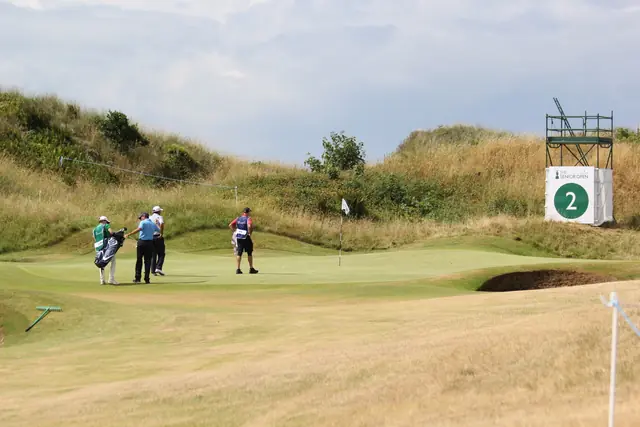
A course framed by dunes
Birkdale's dunes give individual holes a strong sense of enclosure without making the championship easy to read from a distance. A spectator can see a player apparently well placed and still need the next angle, the lie and the wind to understand the shot. The historical interest lies in how different champions have solved that problem, rather than in a single claim that one style of golf always succeeds here.
The course has also continued to change. The R&A published a guide to alterations before the 2026 Open, including changes to the order and design of holes. A hole number in an old championship report should therefore be interpreted in its historical setting. The landscape may be recognisable while the number used by a player or commentator no longer matches a current scorecard. The R&A: changes before the 2026 championship.
1954 and 1965: Thomson's first and last titles
Royal Birkdale had been due to host The Open in 1940, but the Second World War prevented that championship. Its eventual debut came in 1954, when Peter Thomson won with 283, one stroke ahead of Bobby Locke, Dai Rees and Syd Scott. Thomson had already finished runner-up at the previous two Opens. His Birkdale success began a run of three consecutive titles.
He returned to win in 1965, securing the fifth and final Open of his career with 285. The course therefore bookends one of the championship's outstanding records. That later victory is particularly useful when assessing his reputation: Thomson beat a field containing the leading international players of the period. His success was based on repeated mastery of links conditions across different venues and years, rather than on a single favourable week. The R&A: 1954; 1965.
1961: Palmer's attacking championship
Arnold Palmer won in 1961 with 284, one stroke ahead of Rees. The championship was disrupted by severe weather, with the final rounds postponed. Palmer's famous recovery from thick rough helped secure the title. The R&A identifies the hole as the fifteenth at the time and later the sixteenth, another reason to keep old reports attached to their period.
Palmer's presence mattered beyond the winning score. His commitment to The Open helped encourage other leading Americans to travel, and his attacking style gave spectators an immediately recognisable way to follow him. Yet the narrow margin is worth remembering. The dramatic recovery belongs to the story because the championship was close; it should not be allowed to turn a one-stroke contest into a retrospective procession. The R&A: Palmer at Birkdale.
1971: Trevino completes an extraordinary month
Lee Trevino's 1971 victory came after wins at the US Open and Canadian Open, giving him three national Opens within four weeks. At Birkdale he finished on 278, one stroke ahead of Lu Liang Huan. Their final-day contest tightened after Trevino dropped shots late in the round, and both birdied the last.
The result connects a specific course with a wider run of form. Trevino's month is a different achievement from the single championship total, but each helps explain the other. The week also shows why runners-up belong in a meaningful history: Lu's challenge, and the attention he attracted from spectators, helped shape the event even though only one name was engraved on the trophy. The R&A: Trevino's first Open.
1976: Miller wins, Ballesteros emerges
Johnny Miller won the 1976 Open with 279, six strokes ahead of Jack Nicklaus and nineteen-year-old Seve Ballesteros. Miller's closing 66 turned a deficit into a clear victory. Ballesteros's imaginative recovery play, including his running shot at the last, nevertheless made the week an important introduction to a player who would later win three Opens.
Those two stories should be kept in balance. The arrival of a future champion does not diminish Miller's winning performance, and the six-stroke margin does not erase the impression made by the teenager. A championship can be a decisive success for one player and a formative public moment for another. Birkdale's history contains both kinds of significance. The R&A: Miller and Ballesteros.
Watson's fifth, Baker-Finch's breakthrough
Tom Watson won his fifth Open at Royal Birkdale in 1983. His 275 left him one stroke ahead of Andy Bean and Hale Irwin. A controlled approach at the last allowed him to complete the par he needed. This was his first Open victory in England after four titles on different Scottish links.
Ian Baker-Finch won in 1991 with 272, two strokes ahead of Mike Harwood. His weekend scoring transformed the contest, with a fast start on Sunday building on the momentum of the previous round. The two victories illustrate different career contexts: Watson adding another chapter to an exceptional Open record and Baker-Finch securing the major for which he is best remembered. The venue joins those careers without making their experiences identical. The R&A: 1983; 1991.
1998: O'Meara and the leading amateur
Mark O'Meara added The Open to his Masters title in 1998, tying Brian Watts on 280 and winning the play-off. Watts's recovery from a bunker at the final hole had preserved his chance. The additional contest then supplied the separation that regulation play had not.
Justin Rose, still an amateur, finished fourth and won the Silver Medal. His holed approach at the last became one of Birkdale's lasting images. The championship therefore offers another example of a winning professional and a young amateur leaving different marks on the same week. The historical record needs both, with the trophy and the amateur distinction clearly identified rather than treated as equivalent awards. The R&A: O'Meara, Watts and Rose.
2008: Harrington's successful defence
Pádraig Harrington defended the title he had won at Carnoustie by taking the 2008 Open with 283. He finished four strokes ahead of Ian Poulter after a week of difficult wind. His eagle at the seventeenth, set up by a long approach, gave the conclusion a different shape from his play-off victory the previous year.
Greg Norman had led with a round remaining but could not maintain his challenge. The comparison with his earlier Open victories is instructive: experience and knowledge of links golf can keep a player competitive, but they do not guarantee the final result. Harrington's ability to remain effective in the conditions, and to create a decisive opportunity late in the round, completed the defence. The R&A: Harrington retains the Claret Jug.
2017: Spieth recovers after the thirteenth
Jordan Spieth won in 2017 with 268, three strokes ahead of Matt Kuchar, but the final margin conceals the turning point. After a badly misplaced drive at the thirteenth, Spieth took relief and limited the damage to a bogey. He then produced the scoring run that regained control of the championship.
Branden Grace had made 62 the previous day, the first round of that score in a men's major. The two achievements belong to separate categories: Grace's record was an eighteen-hole performance; Spieth's title required the whole week's total. Watching the same championship can produce several historically important results, and a useful account identifies what each one measures. The R&A: the 2017 championship.
2026: Fox adds an eleventh Birkdale Open
Ryan Fox won the 2026 Open with 270, one stroke ahead of Cameron Young. His final-hole birdie completed the victory after a third-round 62 had brought him into contention. He became the second New Zealander to win The Open, following Bob Charles. The result means the course's host table now contains eleven completed editions, rather than ten.
For anyone returning after an earlier visit, the new champion is another reason to read Birkdale as a continuing sporting landscape. Its history now stretches from Thomson's first victory to Fox's final-hole finish, with different conditions and different forms of pressure along the way. The existing venue guide provides current visitor information. The historical table and these stories explain why the same dunes can repay another look. The R&A: Fox's victory; Reuters: the final-hole outcome.
The Ryder Cup and a different kind of finish
Royal Birkdale also staged the Ryder Cup in 1965 and 1969. The second ended sixteen points apiece after Jack Nicklaus conceded Tony Jacklin's final putt, an episode remembered as the Concession. It belongs to the history of match play, where a player can concede a stroke, rather than to the stroke-play system used for The Open. The same last green can therefore carry two quite different forms of sporting memory.
That difference is worth understanding before a visit built around several events. A concession can settle a hole or match without the ball being holed, while a stroke-play competitor normally has to complete the hole. The story of the 1969 finish gains meaning from those rules. It should not be retold as if Nicklaus simply declined an opportunity to win The Open, or as if the tied team result awarded an outright victory to one side. Ryder Cup: official 1969 record; Golf Compendium: the match and Concession.
Championships hosted
Championships at Royal Birkdale appear below, bringing together the competitions covered in this History section. Qualifying courses are included.
| Year | Championship | Course | Champion or winning team | Source note | Sources |
|---|---|---|---|---|---|
| 1909 | Women’s Amateur | Birkdale | Miss D I Campbell | Official championship result | Official · Cross-check |
| 1946 | The Amateur | Birkdale | Jimmy Bruen Jr (Cork) | Official championship result | Official · Cross-check |
| 1948 | Curtis Cup | Royal Birkdale, England | USA | Official championship result | Official · Cross-check |
| 1951 | Walker Cup | Birkdale G.C., Southport, England | USA | Official championship result | Official · Cross-check |
| 1954 | The Open — 83 | Royal Birkdale | Peter Thomson | Official championship result | Official · Cross-check |
| 1961 | The Open — 90 | Royal Birkdale | Arnold Palmer | Official championship result | Official · Cross-check |
| 1962 | Women’s Amateur | Royal Birkdale | Mrs A D Spearman | Official championship result | Official · Cross-check |
| 1963 | PGA Championship | Royal Birkdale | Peter Butler | Reported in part | Official · Cross-check |
| 1964 | British Masters | Royal Birkdale | Cobie Legrange | Reported in part | Cross-check |
| 1965 | Ryder Cup | Royal Birkdale Golf Club (England) | USA | Official championship result | Official · Cross-check |
| 1965 | The Open — 94 | Royal Birkdale | Peter Thomson | Official championship result | Official · Cross-check |
| 1969 | Ryder Cup | Royal Birkdale Golf Club (England) | Tied | Official championship result | Official · Cross-check |
| 1971 | The Open — 100 | Royal Birkdale | Lee Trevino | Official championship result | Official · Cross-check |
| 1976 | The Open — 105 | Royal Birkdale | Johnny Miller | Official championship result | Official · Cross-check |
| 1978 | PGA Championship | Royal Birkdale GC, Southport, England | Sir Nick Faldo | Official championship result | Official · Cross-check |
| 1982 | AIG Women’s Open | Royal Birkdale | Marta Figueras-Dotti (a) | Official championship result | Official · Cross-check |
| 1983 | The Open — 112 | Royal Birkdale | Tom Watson | Official championship result | Official · Cross-check |
| 1986 | AIG Women’s Open | Royal Birkdale | Laura Davies | Official championship result | Official · Cross-check |
| 1989 | The Amateur | Royal Birkdale/Hillside | Stephen Dodd (Brynhill) | Official championship result | Official · Cross-check |
| 1991 | The Open — 120 | Royal Birkdale | Ian Baker-Finch | Official championship result | Official · Cross-check |
| 1998 | The Open — 127 | Royal Birkdale | Mark O’Meara | Official championship result | Official · Cross-check |
| 1999 | Women’s Amateur | Royal Birkdale | Miss M Monnet | Official championship result | Official · Cross-check |
| 2000 | AIG Women’s Open | Royal Birkdale | Sophie Gustafson | Official championship result | Official · Cross-check |
| 2005 | AIG Women’s Open | Royal Birkdale | Jeong Jang | Official championship result | Official · Cross-check |
| 2005 | The Amateur | Royal Birkdale/Southport & Ainsdale | Brian McElhinney (North West) | Official championship result | Official · Cross-check |
| 2008 | The Open — 137 | Royal Birkdale | Padraig Harrington | Official championship result | Official · Cross-check |
| 2010 | AIG Women’s Open | Royal Birkdale | Yani Tseng | Official championship result | Official · Cross-check |
| 2013 | Senior Open | Royal Birkdale GC, Southport, England | Mark Wiebe | Official championship result | Official · Cross-check |
| 2014 | AIG Women’s Open | Royal Birkdale | Mo Martin | Official championship result | Official · Cross-check |
| 2017 | The Open — 146 | Royal Birkdale | Jordan Spieth | Official championship result | Official · Cross-check |
| 2020 | The Amateur | Royal Birkdale | Joe Long (Lansdown) | Official championship result | Official · Cross-check |
| 2026 | The Open — 154 | Royal Birkdale | Ryan Fox | Official championship result | Official · Cross-check |
Sources and useful official links
- Confirmed: Royal Birkdale: club history
- Confirmed: The R&A: course profile
- Confirmed: The R&A: changes before the 2026 championship
- Confirmed: The R&A: 1954
- Confirmed: 1965
- Confirmed: The R&A: Palmer at Birkdale
- Confirmed: The R&A: Trevino's first Open
- Confirmed: The R&A: Miller and Ballesteros
- Confirmed: The R&A: 1983
- Confirmed: 1991
- Confirmed: The R&A: O'Meara, Watts and Rose
- Confirmed: The R&A: Harrington retains the Claret Jug
- Confirmed: The R&A: the 2017 championship
- Confirmed: The R&A: Fox's victory
- Reported: Reuters: the final-hole outcome
- Confirmed: Ryder Cup: official 1969 record
- Reported: Golf Compendium: the match and Concession
Useful reading for your visit
Visit today
- Royal Birkdale visitor guide
- The Open 2027 at St Andrews
- Where to stay in Southport for Royal Birkdale
Some links earn us a small commission at no extra cost to you. Affiliate disclosure.