
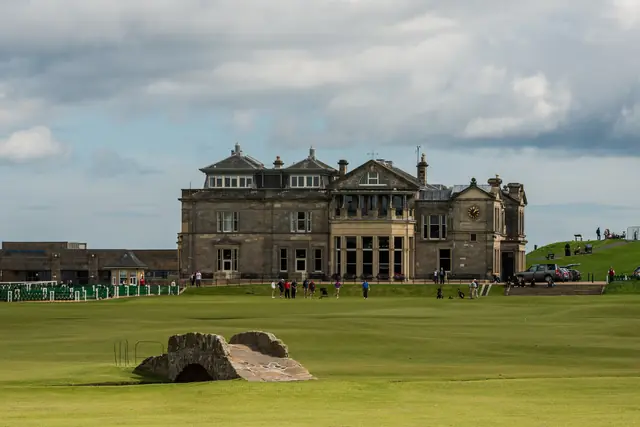

The story behind the championship
There is no official ranking that can settle which Open finish was the greatest. This is an editorial selection of ten final days, chosen to show different kinds of championship drama: direct duels, late recoveries, unexpected ties and a lead that survives the closing holes. They appear in chronological order, without a claim that the first is better than the last.
For editions decided by a play-off, the account includes the extra golf needed to resolve the final-day tie. The distinction matters: a spectacular putt can keep a player in the championship without winning it. Scores and margins below follow the official Open record, with the complete champions table providing the year-by-year context. Each setting also links naturally to a course history and a practical venue guide, so the finish can become a starting point for a visit.
1. St Andrews, 1970: the putt after the putt
Doug Sanders needed par at the last to beat Jack Nicklaus, but missed a short putt and finished tied on 283. The story did not end with that miss. The pair returned for The Open's first 18-hole play-off, in which Nicklaus built a four-stroke advantage before Sanders reduced the gap to one coming to the final hole.
Nicklaus drove to the back of the 18th green and still needed to get up and down as Sanders made birdie. He holed from eight feet to secure his second Open. The finish therefore contains two different final-green tests: Sanders' missed chance in regulation and Nicklaus's converted chance in the decider. Read the Old Course history for the setting, rather than remembering only the better-known miss. Official 1970 record.
2. Turnberry, 1977: two golfers break away
The Duel in the Sun was close at the front and emphatic behind it. Watson and Nicklaus entered the final round level after returning identical scores for three days. Watson's birdie at the 17th gave him a one-stroke advantage, but Nicklaus's remarkable recovery and long birdie putt at the last forced the leader to make his own short birdie attempt.
Watson did, returning 65 for 268 against Nicklaus's 66 for 269. Hubert Green, third on 279, was eleven behind the champion. The result combines exceptional scoring with pressure on a final putt that remained necessary. The separate Duel in the Sun account follows the exchanges in detail; Turnberry's course history explains the place that hosted its first Open that week. Official 1977 record.
3. St Andrews, 1984: a celebration before the result is final
Ballesteros' last-hole birdie created the defining image, but Watson still had golf to play. Seve had negotiated the Road Hole in par and holed from about 12 feet on the 18th; Watson, in the following group, bogeyed the 17th and then could not produce the eagle needed at the last.
The championship finished with Ballesteros on 276, two strokes ahead of Watson and Langer. The fist pump is memorable partly because it makes the release of pressure visible, yet the sequence behind it is just as compelling: rivals in different groups, adjacent holes affecting the same title and a final mathematical chance after the apparent climax. Follow the dedicated 1984 account into the Old Course history for both the 17th and 18th. Official 1984 record.
4. Royal Lytham & St Annes, 1988: a Monday duel
Rain forced The Open to finish on Monday for the first time. Ballesteros began the final round two behind Nick Price and ended with a 65 that gave him a third Claret Jug. The contest was not decided by Price playing poorly throughout: he returned 69, but Seve's run through the middle of the round and his closing short game proved better.
At the 16th, a nine-iron approach finished inches away and helped Ballesteros move ahead. At the last, another precise chip left a short par putt, while Price three-putted. The final totals were 273 and 275. Lytham's history gives this performance a different place from Seve's earlier victory there, and shows why the two championships should not be compressed into one familiar car-park story. Official 1988 record.
5. St Andrews, 1995: Rocca's impossible-looking answer
Costantino Rocca needed birdie at the 18th to tie John Daly. A mishit pitch left him in the Valley of Sin, but he holed an extraordinary long putt up the slope and reached a four-hole play-off. The recovery rescued his championship chance after the preceding stroke appeared to have removed it.
Daly then won the decider by five strokes, with Rocca taking three attempts to escape the Road Hole bunker. Their regulation totals were 282. It is an essential distinction: Rocca supplied the most replayed shot, while Daly completed the winning performance. The final-day story is stronger when both are recognised, rather than treating the remarkable putt as though it also awarded the trophy. The Old Course history places the Valley of Sin and Road Hole in context. Official 1995 record.
6. Carnoustie, 1999: seven keeps a chance alive
Van de Velde led by three on the final tee and could have won with six. His second shot struck a grandstand railing, a later pitch entered the Barry Burn, and a bunker recovery and putt eventually produced seven. The finish created a tie on 290 with Leonard and Lawrie.
Lawrie had started Sunday ten strokes behind and returned 67. He then won the four-hole play-off by three, completing it with birdies at the 17th and 18th. The championship is therefore a record recovery as well as the story of a lost lead. The dedicated Carnoustie 1999 account restores the full sequence, while the course history explains why the burn and closing holes feature so prominently in the venue's championship past. Official 1999 record.
7. Carnoustie, 2007: Harrington survives the burn
Pádraig Harrington began six strokes behind Sergio García. He twice found the Barry Burn on the final hole, but recovered to make double bogey and finish on 277. García still had the chance to win with par at the last; his bogey instead created a play-off.
Harrington birdied the first extra hole while García bogeyed it, establishing an advantage he retained through the decider. The Irishman had won, despite a last regulation hole that could easily dominate a shorter account of the day. Anders Romero also briefly led after making ten birdies, before late dropped shots left him outside the tie. Carnoustie 2007 belongs alongside 1999 as a different championship in which the same closing hazards shaped several contenders' decisions. Official 2007 record.
8. Turnberry, 2009: Watson comes within a par
At 59, Watson birdied the 17th to lead by one and stood on the verge of a sixth Open. His approach to the last ran over the green, and he could not complete the par he needed. Stewart Cink, who had birdied the final hole, joined him on 278.
Cink then played the four-hole decider in two under par while Watson took four over, a six-stroke difference. The result should not be described as an automatic consequence of Watson's miss: Cink had to reach the tie and then win the extra golf. Turnberry's course history connects the event with Watson's 1977 victory, but the different ending is precisely what gives 2009 its own significance. The shared setting does not make the two final approaches the same story. Official 2009 record.
9. Royal Troon, 2016: 63 beats 65
Henrik Stenson began one stroke ahead of Phil Mickelson and closed with 63, including ten birdies, to win on 264. Mickelson's final-round 65 would have been an outstanding winning score in many championships, but it left him second on 267. The next player, J. B. Holmes, finished on 278.
The gaps show why this final round belongs in a selection of great finishes even without a play-off or a final-hole escape. Two players continued producing exceptional golf while the rest finished far behind. Stenson became the first Swedish man to win a major, setting an Open aggregate record in the process. Royal Troon's history supplies the wider championship context, while the scorecard explains the particular standard required to beat Mickelson that afternoon. Official 2016 record.
10. St Andrews, 2022: Smith's inward 30
Cameron Smith began Sunday four strokes behind Rory McIlroy and Viktor Hovland. He then shot 64, with five consecutive birdies from the 10th and a closing nine of 30. His par save at the Road Hole and birdie at the last completed a total of 268.
Playing partner Cameron Young eagled the final hole and finished one stroke behind. McIlroy needed an eagle of his own to tie Smith, but made par and finished third, two back. The decisive action was a sustained run of scoring rather than one isolated miracle stroke. It is a fitting final entry in this selection: the Old Course produced another dramatic finish, yet with a sequence quite different from 1970, 1984 or 1995. Official 2022 record.
Visit the settings
Use the course histories to choose the championship story that interests you, then follow the venue and accommodation guides for current visiting arrangements. The Open hub provides the practical starting point for attending the next edition. The selection is editorial; the winners, totals and venues are historical results that can be checked in the complete champions table.
Sources and useful official links
- Confirmed: Official 1970 record
- Confirmed: Official 1977 record
- Confirmed: Official 1984 record
- Confirmed: Official 1988 record
- Confirmed: Official 1995 record
- Confirmed: Official 1999 record
- Confirmed: Official 2007 record
- Confirmed: Official 2009 record
- Confirmed: Official 2016 record
- Confirmed: Official 2022 record
Useful reading for your visit
Visit today
- St Andrews Old Course visitor guide
- The Open 2027 at St Andrews
- Where to stay for The Open 2027 at St Andrews
Some links earn us a small commission at no extra cost to you. Affiliate disclosure.