

The story behind the championship
Tom Watson won the 1977 Open by one stroke from Jack Nicklaus. The bare result is precise, but it does not explain why this championship became the Duel in the Sun. For two rounds, the leading pair played at a level that carried them away from everyone else. On the final afternoon, each had opportunities to take control, yet neither could make the other disappear. Even on the last hole, with Watson's ball close to the flag and Nicklaus apparently in difficulty, the contest required one more exceptional recovery before it could be settled.
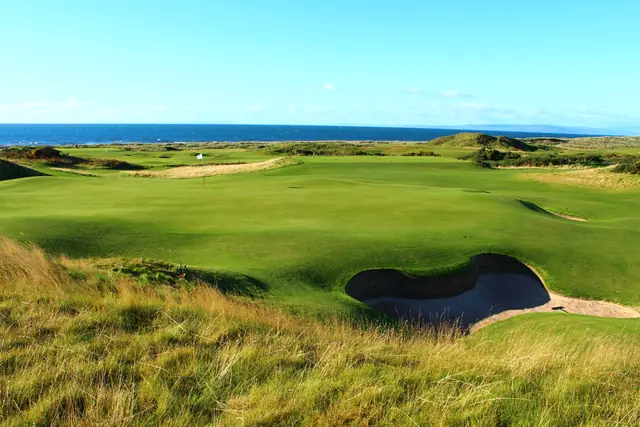
The setting was Turnberry's first Open, played in hot, dry conditions on the Ayrshire coast. Watson finished on 268, Nicklaus on 269 and third-placed Hubert Green on 279. Those three totals are essential to understanding the championship: the margin between the leading pair was tiny, while the distance back to the rest was enormous. Official edition record.
Two established contenders, not a sudden discovery
Watson had already won The Open at Carnoustie in 1975 and the Masters earlier in 1977. Nicklaus arrived with 14 major titles. Their meeting at Turnberry was therefore a contest between a player building a major-winning career and the game's established benchmark, rather than an unknown challenger unexpectedly surviving one afternoon.
They had also recently contested the Masters, where Watson had held off Nicklaus. That history adds context without making the Turnberry result inevitable. Each championship had to be played on its own course, and an earlier victory gave Watson no strokes in Ayrshire. The important connection is competitive: both men knew the standard required to beat the other in a major. The R&A's later documentary account returns to that relationship because it helps explain the quality of the duel. Official documentary background.
Identical cards through three rounds
The pair returned matching scores in each of the first three rounds: 68, 70 and 65. They began the last day tied on 203, three strokes ahead of Ben Crenshaw and at least six in front of everyone else. That symmetry gives the final round a particularly clear starting point. Neither had an advantage to protect, and neither could assume the other's earlier low scoring was an isolated round.
The third-round 65s had already begun to turn a championship into a two-player contest. Yet it remained stroke play. Their immediate rival was beside them, but the winner would still be determined by the lowest four-round total. That distinction matters when interpreting the final holes: a birdie could change the relationship between the leaders even if both were making scores far better than the rest of the field. Official Great Final Days account.
Nicklaus makes the first move
Nicklaus established a three-stroke lead after four holes of the final round. It was a substantial early advantage, especially against an opponent who had started level. Watson then birdied the fifth, seventh and eighth, bringing the contest back into balance before another dropped shot at the ninth left him behind at the turn.
The sequence is more revealing than describing the round as uninterrupted, flawless golf. Watson had to respond to mistakes as well as to Nicklaus's successes. His recovery came through making birdies, not through waiting for the leader to collapse. That became the defining rhythm of the afternoon: an advantage opened, then was challenged by another strong shot or putt. Independent contemporary retrospectives and the organiser's detailed history agree on the broad progression, although compressed summaries sometimes omit the swings between individual holes. Independent account.
The long putt at the 15th
Nicklaus's birdie at the 12th restored a two-stroke cushion. Watson reduced the gap at the 13th, then produced one of the afternoon's decisive strokes at the 15th: a putt from roughly 60 feet, played from off the green, that brought him level again. With three holes left, the championship had returned to the position in which the final round began.
The putt matters because of its place in the sequence. It did not win the Claret Jug on its own, and it did not put Watson ahead. It removed the latest deficit and ensured that the closing holes would be contested from level terms. In a later highlight film, the roar and the length of the putt can make it feel like the final act. The scoreboard shows why the next two holes were still necessary. Official retrospective.
A lead at the 17th
The par-five 17th finally gave Watson an advantage of his own. He reached the green in two and made birdie; Nicklaus missed his birdie opportunity and took par. Watson would go to the last one stroke ahead.
That change transformed the demands of the final hole. If both men made the same score, Watson would win. Nicklaus needed to gain a stroke to force a tie, while Watson could not safely assume that his opponent's chance had gone. Their positions had changed, but the standard of golf made a passive finish unlikely. The decisive question was no longer whether Watson could recover a deficit. It was whether he could complete the championship after taking the lead at the latest useful moment. The organiser's account identifies the 17th as the point at which he first moved in front. Official final-day sequence.
Two birdies at the last
Watson's approach to the 18th stopped about two feet from the hole. Nicklaus had driven into rough near a gorse bush, but recovered to the edge of the green and holed a long birdie putt. The recovery meant Watson still had to make his own birdie to win outright.
The short putt is sometimes lost behind the spectacular strokes that preceded it. It was nevertheless the final requirement. Nicklaus's three had removed any possibility of Watson simply accepting par and the title. Watson converted, completing a final-round 65 against Nicklaus's 66. The scorecards had matched for three rounds; one stroke finally separated them in the fourth. Their finish illustrates why an apparently decisive approach can remain only an advantage until every relevant ball has been holed. Official account comparing Watson's Turnberry approaches.
The numbers behind the memory
Watson's 268 set a new Open aggregate record, eight strokes better than the previous mark. Nicklaus had beaten that earlier record by seven and still finished second. Watson's closing two rounds totalled 130. Those figures show that the duel was not created by one leader falling back towards the field: the two men had established a scoring contest far beyond the other finishers.
Green's 279 left him ten strokes behind Nicklaus and eleven behind Watson. Stating both gaps avoids an error that appears in some retrospective summaries. Third place belongs in the story because it provides scale, rather than because the championship became a literal match with only two entrants. Mark Hayes also recorded an Open-first 63 during the second round, another important achievement from a week whose memory is dominated by the final pair. Official leaderboard and championship summary.
Why the ending lasted
Nicklaus and Watson left the final green together, arms around one another's shoulders. That documented image gives the championship an ending beyond the arithmetic: the winner and runner-up acknowledged a contest in which both had performed exceptionally. It is possible to describe that gesture without assigning private thoughts to either man or inventing a conversation after the final putt.
Watson went on to win three more Opens, while Turnberry returned as a championship venue. His near miss there in 2009 created a separate story at the same final hole. The two editions should not be merged into one nostalgic account: in 1977 he completed the birdie needed to win, whereas the later championship ended differently. The enduring connection is the course and the pressure of its closing approach. Official Turnberry history; Watson's two Turnberry finishes.
Connect the story with a visit
Read the Turnberry course history before the practical venue guide, then compare Ayrshire accommodation bases. The modern Ailsa has changed since 1977, so use a current course plan alongside the historical account. The Open hub covers the next championship trip; Turnberry's own present arrangements determine how to visit the setting of the duel.
Sources and useful official links
Useful reading for your visit
Visit today
- Trump Turnberry: a visitor’s guide
- The Open 2027 at St Andrews
- Where to stay for Troon and Ayrshire golf
Some links earn us a small commission at no extra cost to you. Affiliate disclosure.