
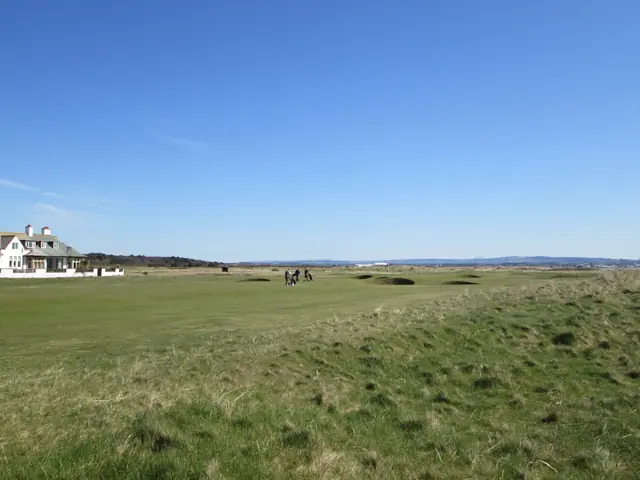

Ayrshire's later championship links
Royal Troon sits in a coastline with a much older Open connection at neighbouring Prestwick, but its own championship identity developed later. The club's history records a formation meeting in 1878 and describes an initial layout of five or six holes, prepared with guidance from Prestwick greenkeeper Charles Hunter. It is more accurate to preserve that qualification than to turn the club's uncertainty into a precise opening scorecard.
The course expanded, Willie Fernie contributed to its development and James Braid modified it after the First World War. Its first Open arrived in 1923. The Royal title followed in the club's centenary year, 1978, so earlier championship accounts often call the venue simply Troon. That difference in naming does not mean that the 1923, 1950 or 1962 championships took place at another course. Royal Troon: the course's development; The R&A: Royal status and the 1982 Open.
The Postage Stamp and the Railway
Troon rewards close attention to scale. Its eighth hole, the Postage Stamp, has a small target and surrounding bunkers that can make a short approach much more demanding than its length suggests. The eleventh brings the railway into the golfer's view and gives the course another immediately recognisable feature. These are different kinds of pressure: precision at a small green, and the need to commit to a line beside visible trouble.
The routing is often summarised as nine holes out and nine back. The club's own account prefers a more nuanced reading: an opening group heading out, a middle stretch changing direction and a final group returning towards the clubhouse. Watching that pattern helps explain why the wind cannot be reduced to one favourable outward journey and one difficult inward journey. A links round keeps changing the relationship between distance, angle and the shot a player can safely attempt.
1923: Havers wins from the sand
Arthur Havers won the first Open at Troon with 295, one stroke ahead of defending champion Walter Hagen. Havers finished by holing from a bunker beside the last green. Hagen found the same bunker but could not reproduce the recovery. It is a compact example of the championship's recurring balance between a poor position and a decisive response.
The result also places Troon within the competition's changing international character. Vardon, Braid and Taylor were still in the field, but the title went to an Englishman confronting the American who had won the previous year and would win again. The venue's first champion was not simply confirming an established hierarchy. The finishing bunker became the place where a particular opportunity was taken. The R&A: Havers and Hagen.
1950: Locke's successful defence
The Open did not return until 1950, when Bobby Locke defended the title he had won at Royal St George's. His 279 won by two strokes according to The R&A and the club's own championship history. That official margin is retained in the results table; a differing runner-up total in a secondary results source is identified in the table's footnote.
Locke's championship shows why a famous difficult venue need not always produce a high winning score. The R&A describes little wind and good putting surfaces during the week. His deliberate method and precision suited the particular examination. It is the combination of course, preparation and conditions that produces a championship, rather than the course's reputation operating independently of the weather. The R&A: Locke in 1950; Royal Troon's official championship history.
1962: Palmer separates himself
Arnold Palmer won in 1962 with 276, six strokes clear of Kel Nagle. His third-round 67 created the decisive advantage. This was a successful defence of the Claret Jug after his Royal Birkdale victory in 1961, and an important part of his association with the championship at a time when leading American participation was growing.
Jack Nicklaus made his Open debut in the same week. His difficulties included a ten at the eleventh, an experience that belongs to a very different stage of his career from his later victories. Reading those two stories together adds depth to the venue: Palmer at his most effective and Nicklaus beginning a long education in links golf. A famous course can be a place of mastery for one player and of difficult apprenticeship for another at exactly the same championship. The R&A: Palmer's defence.
1973: a champion and a farewell
Tom Weiskopf won the 1973 Open with 276, three strokes ahead of Johnny Miller and Neil Coles. He led throughout the seventy-two-hole championship. His control of the event provides a useful counterweight to the venue's better-known play-offs: Troon has sometimes rewarded a player who established command early and kept it.
The Postage Stamp supplied another story when seventy-one-year-old Gene Sarazen made a hole-in-one there. Sarazen had played in Troon's first Open fifty years earlier. The contrast between the new champion and the veteran's final appearances gave the same week two different historical meanings. One was the culmination of a player competing at his peak; the other linked spectators with an earlier generation and a championship Sarazen had himself won in 1932. The R&A: Weiskopf's title and Sarazen's ace.
1982: Watson stays in contention
Tom Watson's 1982 victory brought his fourth Open title. Bobby Clampett had led early and Nick Price later appeared well placed, but Watson finished on 284 to win by one over Price and Peter Oosterhuis. The championship is remembered partly for lost advantages; Watson's own work in remaining close enough to benefit is equally important.
The outcome demonstrates a practical difference between being the most visible player at one stage and being the eventual winner. A leaderboard changes over seventy-two holes, and an apparently quiet round can preserve a valuable position. Watson had already won the US Open that summer. His Troon victory belongs within an exceptional season as well as within the history of this particular stretch of Ayrshire coast. The R&A: Watson's fourth Open.
1989: a shorter play-off changes the finish
Mark Calcavecchia, Greg Norman and Wayne Grady tied on 275 in 1989. The Open then used its first four-hole aggregate play-off. Norman began the additional contest quickly but ran into trouble at the finish, while Calcavecchia produced the approach that secured the title. The change in format is part of the event's history, rather than a detail to be silently applied to earlier editions.
Comparisons with the eighteen-hole play-offs of previous decades therefore need care. The players in 1989 faced a concentrated test over a selected stretch of the course. There was less time to recover from an expensive error, and the final hole carried immediate significance. For spectators, it also meant that a tied championship could reach its conclusion through a short additional contest that afternoon. The R&A: the first four-hole play-off.
Leonard and Hamilton continue the American sequence
Justin Leonard won in 1997 after starting the final day five strokes behind. His closing 65 brought a three-stroke victory over Darren Clarke and Jesper Parnevik. The outcome was a reminder that a player can gain ground through exceptional scoring while the leaders also find the closing stretch difficult. Leonard's putting, rather than an assumed advantage in power, drove his challenge.
Todd Hamilton followed in 2004, tying Ernie Els on 274 and winning the play-off. His use of a hybrid for running recovery shots became a memorable part of the week. By then six successive Troon Opens had been won by Americans, beginning with Palmer in 1962. That sequence describes completed results, not an inherent national advantage: the next champion would come from Sweden. The R&A: Leonard in 1997; Hamilton in 2004.
2016: Stenson and Mickelson raise the standard
Henrik Stenson won the 2016 Open with 264, twenty under par and three strokes ahead of Phil Mickelson. The raw total set a championship record. His final-round 63 included ten birdies, while Mickelson shot 65 without a bogey. It was a contest in which excellent golf by the runner-up still proved insufficient.
The comparison with Turnberry in 1977 is understandable, but the two events should retain their own identities. Stenson became the first Swedish winner of a men's major, and his score established a different statistical benchmark from Watson's earlier duel with Nicklaus. Anyone comparing record totals should also separate strokes from scores relative to par: both measures matter, but they describe different aspects of an achievement. The R&A: Stenson's record victory.
How to compare the championships
The winning totals range from Havers's 295 to Stenson's 264. Those numbers should not be read as a simple measurement of which player faced the harder task. Different championship preparations, playing conditions and equipment form part of the comparison. Nor does a lower winning total necessarily mean a closer contest: Stenson won by three, while Watson won by one with a much higher total. The margin measures the relationship between players in the same event; the total records the strokes used in that event. Keeping both alongside the venue and year gives a more useful historical picture than ranking every champion by score alone.
2024: another controlled final round
Xander Schauffele won the 2024 championship with 275, two strokes ahead of Justin Rose and Billy Horschel. His closing 65 followed a week in which wind and rain had made control of the ball especially valuable. The result gave him a second major of the season after the PGA Championship.
Through that edition, Troon had hosted ten Opens and produced ten different champions. The full table keeps every result in view, from Havers's bunker finish to Schauffele's final-round control. Current visitors can use that sequence to understand the course without assuming that a famous hole has only one story. The Postage Stamp, Railway and closing stretch have tested different equipment, strategies and generations. Practical arrangements belong in the venue guide; the history provides the reasons to look closely when you arrive. The R&A: the 2024 championship.
Championships hosted
Championships at Royal Troon appear below, bringing together the competitions covered in this History section. Qualifying courses are included.
| Year | Championship | Course | Champion or winning team | Source note | Sources |
|---|---|---|---|---|---|
| 1904 | Women’s Amateur | Troon | Miss L Dod | Official championship result | Official · Cross-check |
| 1923 | The Open — 58 | Troon | Arthur Havers | Official championship result | Official · Cross-check |
| 1925 | Women’s Amateur | Troon | Miss J Wethered | Official championship result | Official · Cross-check |
| 1938 | The Amateur | Troon | Charlie Yates (USA) | Official championship result | Official · Cross-check |
| 1950 | The Open — 79 | Troon | Bobby Locke | Official championship result | Official · Cross-check |
| 1952 | Women’s Amateur | Troon | Miss M C Paterson | Official championship result | Official · Cross-check |
| 1956 | The Amateur | Troon | John Beharrell (Little Aston) | Official championship result | Official · Cross-check |
| 1962 | The Open — 91 | Troon | Arnold Palmer | Official championship result | Official · Cross-check |
| 1968 | The Amateur | Troon | Michael Bonallack (Thorpe Hall) | Official championship result | Official · Cross-check |
| 1973 | The Open — 102 | Troon | Tom Weiskopf | Official championship result | Official · Cross-check |
| 1978 | The Amateur | Royal Troon | Peter McEvoy (Copt Heath) | Official championship result | Official · Cross-check |
| 1982 | The Open — 111 | Royal Troon | Tom Watson | Official championship result | Official · Cross-check |
| 1984 | Women’s Amateur | Royal Troon | Miss J Rosethal | Official championship result | Official · Cross-check |
| 1989 | The Open — 118 | Royal Troon | Mark Calcavecchia | Official championship result | Official · Cross-check |
| 1997 | The Open — 126 | Royal Troon | Justin Leonard | Official championship result | Official · Cross-check |
| 2003 | The Amateur | Royal Troon/Irvine | Gary Wolstenholme (Kilworth Springs) | Official championship result | Official · Cross-check |
| 2004 | The Open — 133 | Royal Troon | Todd Hamilton | Official championship result | Official · Cross-check |
| 2008 | Senior Open | Royal Troon GC, Ayrshire, Scotland | Bruce Vaughan | Official championship result | Official · Cross-check |
| 2012 | The Amateur | Royal Troon/Glasgow (Gailes) | Alan Dunbar (Rathmore) | Official championship result | Official · Cross-check |
| 2016 | The Open — 145 | Royal Troon | Henrik Stenson | Official championship result | Official · Cross-check |
| 2017 | Scottish Open | Dundonald Links, Troon, Ayrshire, Scotland | Rafa Cabrera Bello | Official championship result | Official · Cross-check |
| 2020 | AIG Women’s Open | Royal Troon | Sophia Popov | Official championship result | Official · Cross-check |
| 2024 | The Open — 152 | Royal Troon | Xander Schauffele | Official championship result | Official · Cross-check |
Sources and useful official links
- Confirmed: Royal Troon: the course's development
- Confirmed: The R&A: Watson's fourth Open
- Confirmed: The R&A: Havers and Hagen
- Confirmed: The R&A: Locke in 1950
- Confirmed: Royal Troon's official championship history
- Confirmed: The R&A: Palmer's defence
- Confirmed: The R&A: Weiskopf's title and Sarazen's ace
- Confirmed: The R&A: the first four-hole play-off
- Confirmed: The R&A: Leonard in 1997
- Confirmed: Hamilton in 2004
- Confirmed: The R&A: Stenson's record victory
- Confirmed: The R&A: the 2024 championship
Useful reading for your visit
Visit today
Some links earn us a small commission at no extra cost to you. Affiliate disclosure.