
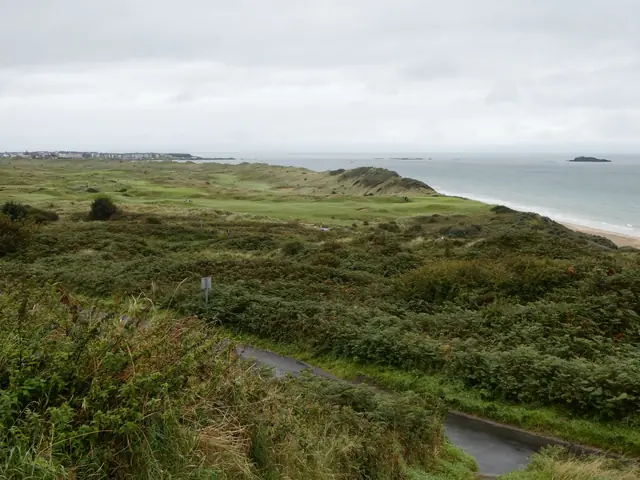

From the County Club to Royal Portrush
Royal Portrush began in 1888 as the County Club. The R&A records an extension to eighteen holes the following year and the adoption of the Royal Portrush name in 1895. The club's story belongs to the wider development of Portrush as a place people travelled to for the coast, recreation and organised sport. Its later championship status grew out of that local setting rather than replacing it.
The distinction between club and course dates is important. Harry Colt did not design the original 1888 ground. His plans for the Dunluce Links came in 1929, with the resulting work shaping the championship course of the inter-war period. Calling the entire course an untouched Victorian layout misses a substantial stage in its development. The R&A: Portrush's origins and development.
A history that includes women and amateurs
Portrush's place in championship golf was established before its first men's Open. The Women's Amateur came here in 1895, and the club became associated with leading players including May Hezlet and Rhona Adair. The Ulster Museum's account documents the Ladies Club and the Hezlet family through material preserved in its collections. Those players should be treated as part of the venue's central history, rather than as an optional addition to a later men's championship story.
Hezlet won three Women's Amateur titles, in 1899, 1902 and 1907. The dates identify her achievements, but a venue history must distinguish titles won by a member from championships actually played at that member's home club. A connection with Portrush is not evidence that every associated victory happened here. The same care applies when reading the careers of the modern professionals connected with the town. Ulster Museum: early Portrush golf and its collections.
1951: The Open leaves Great Britain
In 1951 Royal Portrush became the first Open venue outside Great Britain. Max Faulkner won with 285, two strokes ahead of Antonio Cerdá. He had led by six after three rounds but still had to complete a closing 74 and wait for his closest challenger to finish. Fred Daly, the 1947 champion and a Portrush player, was among those competing on familiar ground.
The result gave the course a place in a championship geography that had previously been confined to Scotland and England. It did not create a routine return schedule. Sixty-eight years passed before the next Portrush Open. That interval is central to the venue's story: hosting a successful championship established a historical fact, but securing another edition required a later generation of work and decisions. The R&A: the 1951 championship.
A famous Faulkner story needs a qualification
Faulkner is sometimes said to have signed autographs describing himself as Open champion before the competition was over. The R&A's own account treats the familiar version with caution. It offers a more qualified sequence and also raises the possibility that newspaper storytelling helped create the legend. It should therefore be labelled a disputed anecdote, not repeated as a verified quotation or evidence that he considered victory certain.
The distinction does not diminish the achievement. Faulkner's rounds and the final margin are documented results; the autograph story is a separate question about how sporting memory develops. A course history is more useful when it allows a colourful story to remain uncertain than when it gives the story artificial authority by placing it beside a reliable scorecard.
The long road back to championship status
The R&A's account of the return to Portrush describes sustained efforts to restore the club's profile after difficult years for visitors and events in Northern Ireland. The Amateur Championship in 1993 and subsequent Senior Opens formed part of that process. These were significant competitions in their own right, while also demonstrating that the club could organise events and welcome spectators.
The modern return was therefore not a single announcement detached from the preceding decades. It involved club administration, course condition, event experience and the practical capacity to move people around the site. For visitors, that background helps explain why an Open is more than eighteen good holes. The surrounding arrangements determine whether the event can function at the scale its international audience expects. The R&A: how the return was secured.
2012: the Irish Open provides a demonstration
Jamie Donaldson won the 2012 Irish Open at Portrush, finishing eighteen under par with a four-stroke margin. It was his first European Tour victory, secured on his 255th appearance. The event drew substantial crowds and gave the venue another opportunity to demonstrate its capacity for a major professional gathering.
Donaldson's final-round 66 was the best of his four rounds. Local interest did not guarantee a local winner: the Welshman completed the strongest week while established Irish and Northern Irish players competed around him. That is a useful distinction in a venue history. A tournament can be an important event for its host community while its sporting outcome belongs to a visiting player. DP World Tour: Donaldson's victory; RTÉ: independent result report.
Two new holes change the Dunluce Links
Preparing for the 2019 Open involved a major architectural decision. Two new holes, becoming the seventh and eighth, replaced the old seventeenth and eighteenth. Martin Ebert's work allowed the closing sequence to change and freed space needed for the championship operation. The R&A documented the project rather than presenting the return as an unchanged replay of 1951.
The change affects how records should be described. A low round on the earlier layout and a low round on the reconfigured Dunluce are not identical course-record categories. Rory McIlroy's 61 as a teenager in 2005 remains a notable achievement, while Shane Lowry's 63 in 2019 established a mark on the changed course. Keeping the layout attached to the number protects the significance of both rounds. The R&A: the new holes; old and new records.
Calamity Corner and a choice of misses
The long par-three Calamity Corner, now the sixteenth, has become the course's most recognisable championship test. The right side falls sharply away, so the apparent temptation to aim left has its own history. The R&A describes Bobby Locke's decision in 1951 to play towards the hollow on that side and rely on recovering for par.
The hole illustrates how a famous name can preserve a strategic decision. Locke's Hollow is not merely a picturesque label: it records a judgement about the relative risks of different misses. The same decision will not always be correct for every player or wind, but it gives spectators a useful way to watch. A player aiming away from the flag may be choosing the most sensible route rather than failing to attack. The R&A: Calamity Corner.
2019: Lowry wins the returning Open
Shane Lowry won the 2019 championship with 269, six strokes ahead of Tommy Fleetwood. His third-round 63 created a four-stroke lead, and a closing 72 completed the title. The week was a significant return for Northern Ireland, but the winning achievement belonged to a golfer from the Republic of Ireland. Accurate nationality labels allow the wider island's shared golfing interest and the organiser's classifications to coexist.
Lowry's final round was not a continuation of Saturday's low scoring. He had to manage different conditions and the pressure of a lead. The distinction makes the achievement more instructive: a championship can require an attacking round to create separation and a more measured round to preserve it. The numbers in the table tell that sequence more clearly than a single photograph of the trophy presentation. The R&A: the 2019 championship.
2025: Scheffler establishes another benchmark
Scottie Scheffler won the third Portrush Open in 2025 with 267, four strokes clear of Harris English. The American's result supplied a different kind of final day from Lowry's six years earlier: a player already established at the top of the game converted control of the championship into a first Claret Jug.
Rory McIlroy's presence added substantial local interest, but Scheffler's scoring determined the outcome. He responded to a double bogey at the eighth in the final round with later birdies rather than allowing the mistake to dictate the remainder. The winning total improved the previous two Portrush Open totals, although comparisons still need to recognise the course's changes since 1951. The R&A: the 2025 championship; Reuters: independent account.
A debut with consequences beyond Portrush
The 1951 championship also introduced Peter Thomson to The Open. He was 21, part of a field that the R&A records as 183 players representing 14 countries. His later five victories, including the consecutive wins of 1954, 1955 and 1956, give that debut a significance that the final leaderboard alone cannot convey. Portrush was the beginning of his championship career rather than its defining triumph. Remembering the newcomer alongside the winner broadens the picture of an event often reduced to Faulkner and his nervous final round. The R&A: Portrush and Thomson’s debut.
Three Opens within a much wider history
The completed Open record is now three editions: 1951, 2019 and 2025. Amateur, women's, senior and Irish Open results belong beside that table under their own competition headings. Their dates help explain the development of the venue without artificially inflating the men's Open count.
Plan a visit with that longer perspective. The Dunluce's design, the early women's game, the long campaign to restore championship golf and the recent winners offer several reasons to explore the Causeway Coast. Current access and accommodation information can turn the interest into a practical trip; the history explains why time here is worthwhile even between major events.
Championships hosted
Championships at Royal Portrush appear below, bringing together the competitions covered in this History section. Qualifying courses are included.
| Year | Championship | Course | Champion or winning team | Source note | Sources |
|---|---|---|---|---|---|
| 1895 | Women’s Amateur | Royal Portrush | Lady Margaret Scott | Official championship result | Official · Cross-check |
| 1903 | Women’s Amateur | Royal Portrush | Miss R Adair | Official championship result | Official · Cross-check |
| 1911 | Women’s Amateur | Royal Portrush | Miss D I Campbell | Official championship result | Official · Cross-check |
| 1924 | Women’s Amateur | Royal Portrush | Miss J Wethered | Official championship result | Official · Cross-check |
| 1930 | Irish Open | Royal Portrush (Dunluce) | Charles Whitcombe | Official championship result | Official · Cross-check |
| 1937 | Irish Open | Royal Portrush (Dunluce) | Bert Gadd | Official championship result | Official · Cross-check |
| 1939 | Women’s Amateur | Royal Portrush | Miss P Barton | Official championship result | Official · Cross-check |
| 1947 | Irish Open | Royal Portrush (Dunluce) | Harry Bradshaw | Official championship result | Official · Cross-check |
| 1951 | The Open — 80 | Royal Portrush | Max Faulkner | Official championship result | Official · Cross-check |
| 1955 | Women’s Amateur | Royal Portrush | Mrs G Valentine | Official championship result | Official · Cross-check |
| 1960 | The Amateur | Royal Portrush | Joe Carr (Sutton) | Official championship result | Official · Cross-check |
| 1969 | Women’s Amateur | Royal Portrush | Mlle C Lacoste | Official championship result | Official · Cross-check |
| 1993 | The Amateur | Royal Portrush (Dunluce & Valley) | Iain Pyman (Sand Moor) | Official championship result | Official · Cross-check |
| 1995 | Senior Open | Royal Portrush GC, Portrush, County Antrim, Northern Ireland | Brian Barnes | Official championship result | Official · Cross-check |
| 1995 | Women’s Amateur | Royal Portrush | Mrs J Hall | Official championship result | Official · Cross-check |
| 1996 | Senior Open | Royal Portrush GC, Portrush, County Antrim, Northern Ireland | Brian Barnes | Official championship result | Official · Cross-check |
| 1997 | Senior Open | Royal Portrush GC, Portrush, County Antrim, Northern Ireland | Gary Player | Official championship result | Official · Cross-check |
| 1998 | Senior Open | Royal Portrush GC, Portrush, County Antrim, Northern Ireland | Brian Huggett Mbe | Official championship result | Official · Cross-check |
| 1999 | Senior Open | Royal Portrush GC, Portrush, County Antrim, Northern Ireland | Christy O'Connor Jnr | Official championship result | Official · Cross-check |
| 2004 | Senior Open | Royal Portrush GC, Portrush, County Antrim, Northern Ireland | Pete Oakley | Official championship result | Official · Cross-check |
| 2011 | Women’s Amateur | Royal Portrush | Miss L Taylor | Official championship result | Official · Cross-check |
| 2012 | Irish Open | Royal Portrush GC, Portrush, County Antrim, Northern Ireland | Jamie Donaldson | Official championship result | Official |
| 2014 | The Amateur | Royal Portrush/Portstewart | Bradley Neil (Blairgowrie) | Official championship result | Official · Cross-check |
| 2019 | The Open — 148 | Royal Portrush | Shane Lowry | Official championship result | Official · Cross-check |
| 2025 | The Open — 153 | Royal Portrush | Scottie Scheffler | Official championship result | Official · Cross-check |
Sources and useful official links
- Confirmed: old and new records
- Confirmed: Ulster Museum: early Portrush golf and its collections
- Confirmed: The R&A: the 1951 championship
- Confirmed: The R&A: how the return was secured
- Confirmed: DP World Tour: Donaldson's victory
- Confirmed: RTÉ: independent result report
- Confirmed: The R&A: the new holes
- Confirmed: The R&A: Calamity Corner
- Confirmed: The R&A: the 2019 championship
- Confirmed: The R&A: the 2025 championship
- Reported: Reuters: independent account
- Confirmed: The R&A: Portrush and Thomson’s debut
Useful reading for your visit
Visit today
- Royal Portrush visitor guide
- The Open 2027 at St Andrews
- Where to stay for Portrush and the Causeway Coast
Some links earn us a small commission at no extra cost to you. Affiliate disclosure.