Before you book
A golf trip to Évian can involve a French tournament, a Swiss airport and a hotel on either side of Lake Geneva. Arrange the paperwork for both countries before comparing journeys. This guide covers ordinary short visits by British citizens travelling from the UK; another nationality, residence permit or purpose of travel can change the requirements.
Check your passport before booking
For France and Switzerland, check two separate dates. Your passport must have been issued less than ten years before your arrival, and its expiry must be at least three months after you intend to leave the Schengen area. A passport can look comfortably in date yet fail the issue-date test. Read the current GOV.UK France entry requirements and Switzerland entry requirements, including any rules affecting your particular passport.
Use the date you leave Schengen for the validity calculation, rather than the date you leave France for Switzerland. Keep your accommodation confirmation and onward travel details accessible. Put the name on every reservation beside the passport and resolve discrepancies before departure. A screenshot of a passport is useful backup information; it does not replace the document at a border.
Count the whole Schengen stay
British citizens can normally make tourist visits of up to 90 days in any rolling 180-day period without a visa. France and Switzerland both count towards the same allowance. Crossing Lake Geneva does not restart the clock, and earlier holidays elsewhere in Schengen may affect the days available for your golf trip. Use the EU's official remaining-stay tool if several journeys overlap.
Do this before committing to an extended summer itinerary. A tournament week may be short, but a spring holiday, a longer stay with relatives and an autumn break can together make the calculation less obvious. Anyone planning paid work, a stay beyond the visitor allowance or travel under a residence permit should follow the relevant government guidance for that situation.
EES: allow time at the border
The Entry/Exit System is the digital Schengen border-registration system. GOV.UK's current guidance describes registration of biometric details, including a photograph and fingerprints, when required. Registration is free. Children aged eleven or younger are exempt from fingerprint collection, although photographs can still be required. Follow the instructions of border staff and your carrier; EES is not a commercial application to buy before travelling.
First registration can add time to the journey. Do not arrange a tight airport-to-train connection on the assumption that passport control will be instant. The same practical buffer matters on the way home, when checks can take place before reaching the departure gate. Read GOV.UK's EES guidance and the EU's official EES information. Border procedures and exemptions should be rechecked shortly before departure.
ETIAS: current status, not a predicted launch
Checked on 19 October 2026, the European Commission's ETIAS page says ETIAS is not operating and applications are not being collected. Do not pay an intermediary for an authorisation that cannot currently be issued. The official site is Travel Europe.
A 2027 golf booking does not establish which border arrangements will apply when you travel. Revisit the official information when your transport dates approach, and again before departure. EES and ETIAS are different systems: completing a border registration does not mean that a future travel-authorisation requirement can be ignored. Recheck the official status before your 2027 departure.
GHIC, insurance and medicines
An eligible UK Global Health Insurance Card, or valid applicable EHIC, provides access to medically necessary state healthcare in France and Switzerland under the relevant arrangements. Treatment can involve patient charges. Apply through the NHS's free official service, check the card's validity and read the eligibility conditions rather than assuming residence alone settles every case.
Carry travel insurance as well. The France health advice and Swiss health advice explain exclusions such as private treatment and repatriation. Tell the insurer about medical conditions and check cancellation, missed connections and any extra activities. A policy should cover both countries if your itinerary crosses the lake.
Keep essential medication accessible during travel. Read TravelHealthPro's France advice and Switzerland advice, including medicine guidance and current health risks. GOV.UK recommends checking health advice at least eight weeks ahead where possible. Ask a clinician about individual needs; a packing list cannot decide whether a medicine or vaccination is appropriate for you.
Euros, francs and charging your phone
France uses euros. Switzerland uses Swiss francs, including Lausanne. Some Swiss businesses accept euros, but this is not a promise that every payment will be possible in euros or that change will be returned in them. Switzerland Tourism's currency guide explains the distinction. Check your card's foreign-currency fees and carry a backup payment method separately.
France's standard socket system includes type E; pack an adaptor suitable for your UK plugs. France's official tourism information identifies the plug type. Switzerland uses type J sockets and also accepts the appropriate two-pin type C plugs, as explained by Switzerland Tourism. Choose equipment specifically marked as suitable for the country and your appliance. Do not force a plug into a socket or assume every European adaptor is interchangeable.
Driving: prepare the car as well as the route
Traffic drives on the right in France and Switzerland. Read the French road-travel advice and Swiss road-travel advice. Carry your valid driving licence and the vehicle documents appropriate to ownership or hire. The GOV.UK driving-abroad checklist explains registration papers, insurance and arrangements for a hired or leased vehicle. Ask the rental company explicitly about crossing the French–Swiss border.
Check whether your registration plate needs an additional UK identifier. GOV.UK's number-plate rules distinguish plates bearing UK with the Union flag from other designs; an old GB sticker is not the current identifier. Vehicle-insurance guidance confirms that valid cover is still essential even where a green card is unnecessary. Confirm the level of cover, breakdown assistance and any territorial exclusions with your insurer.
French low-emission restrictions depend on the places you drive through. Check the official Crit'Air service for your vehicle and route rather than buying a sticker from an unofficial seller. Do not assume that avoiding a city centre guarantees that every approach road is unrestricted.
Swiss motorway use requires the appropriate vignette. The Swiss government's vignette guide covers the sticker and electronic options. Check whether a hire vehicle already has the required cover before purchasing another. Plan the journey to the event's designated parking, not simply to the clubhouse address.
Roaming, eSIMs and offline backups
Do not assume your UK tariff includes either country. GOV.UK's roaming guidance says surcharge-free EU roaming is not guaranteed. Switzerland must be checked separately in your network's destination list. Read the actual allowance, fair-use limits and charges for your contract; a general European marketing label is not enough.
An eSIM may be an option if your handset supports it and is unlocked for the service. Check coverage for both countries, whether calls and texts are included, and when the validity period begins. Download the event ticket through its official system and retain booking references, accommodation details and journey information offline. Keep the home SIM settings under control if another line supplies your data.
Emergencies and useful French
Save 112 for emergency assistance in either country. France also uses 15 for medical emergencies; Switzerland uses 144 for an ambulance. The Swiss official tourism emergency list and the relevant GOV.UK health pages are useful references. At the tournament, tell a steward where help is needed and identify the nearest numbered hole or other clear landmark.
A few simple phrases help: bonjour means hello; merci means thank you; s'il vous plaît means please; où est la gare? asks where the station is; un billet aller-retour means a return ticket; and parlez-vous anglais? asks whether someone speaks English. Show a written destination when pronunciation is uncertain. Keep the exact place name from your booking rather than translating an address.
Put the travel plan beside the golf plan
Before leaving, connect these practical arrangements with the Evian Championship guide. Check the last usable return journey before choosing how long to stay at the course. A ferry arrival is only one part of a journey involving a train, bus or walk afterwards. Keep a realistic alternative if weather, play or transport disruption changes the evening.
Use the packing guide and first-time spectator guide alongside the official event's admission rules. Pack for a long outdoor day while respecting the tournament's bag policy. The most useful final check is simple: everyone in the group should know where they are sleeping, how they are getting back and which official updates they will follow.
Local rules, customs and Geneva car hire
In France, you must be able to prove your identity when asked; GOV.UK explains the accepted documents and police procedure. Check individual shop and restaurant opening days when planning Sunday supplies, and check for a service charge before deciding whether to tip.
Geneva Airport has separate French and Swiss car-hire arrangements. Confirm the collection and return sector, permission to cross the border and motorway equipment with the rental company. The airport’s internal French-sector access is restricted to qualifying air travellers around their flight date; other access may need the external French road. Confirmed: airport car hire · French-sector access.
In Switzerland, call 112 for general emergencies, 117 for police, 118 for fire or 144 for an ambulance. Confirmed: Swiss emergency numbers.
For a road-transfer starting point, Hôtel Alizé’s own access information gives about one hour from Geneva Airport to central Évian. This is a normal-traffic hotel estimate, not an event shuttle timetable; allow extra time for traffic, collection and your onward trip to the course. Source: the hotel’s airport access information.
Sources and useful official links
- Confirmed: GOV.UK France entry requirements
- Confirmed: Switzerland entry requirements
- Confirmed: EU's official remaining-stay tool
- Confirmed: GOV.UK's EES guidance
- Confirmed: EU's official EES information
- Confirmed: European Commission's ETIAS page
- Confirmed: Travel Europe
- Confirmed: NHS's free official service
- Confirmed: France health advice
- Confirmed: Swiss health advice
- Confirmed: TravelHealthPro's France advice
- Confirmed: Switzerland advice
- Confirmed: Switzerland Tourism's currency guide
- Confirmed: France's official tourism information
- Confirmed: Swiss official tourism emergency list
- Confirmed: French road-travel advice
- Confirmed: Swiss road-travel advice
- Confirmed: GOV.UK driving-abroad checklist
- Confirmed: GOV.UK's number-plate rules
- Confirmed: Vehicle-insurance guidance
- Confirmed: Crit'Air service
- Confirmed: vignette guide
- Confirmed: GOV.UK's roaming guidance
- Confirmed: 15 for medical emergencies
You might also like
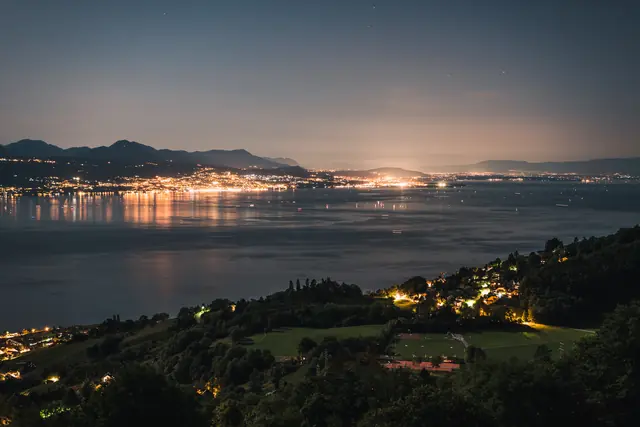

Evian Championship 2027
Confirmed: The Amundi Evian Championship takes place from 8–11 July 2027 at Evian Resort Golf Club in Évian-les-Bains. Our suggestion: stay on the French shore for several days of golf, or use Lausanne for a holiday combining the championship with the lake.

Evian Championship and Lake Geneva: four days
Stay in Évian-les-Bains for your golf day, cross to Lausanne on a separate sightseeing day and finish in Geneva. Our suggestion combines one championship visit with time on both sides of Lake Geneva.
Where to stay for the Evian Championship
Our suggestion: stay in Évian-les-Bains for the simplest golf-focused break, or compare Thonon-les-Bains if your daily connection works. Lausanne adds a lake crossing and Geneva adds a longer approach, so choose those bases for a wider holiday rather than proximity alone.