
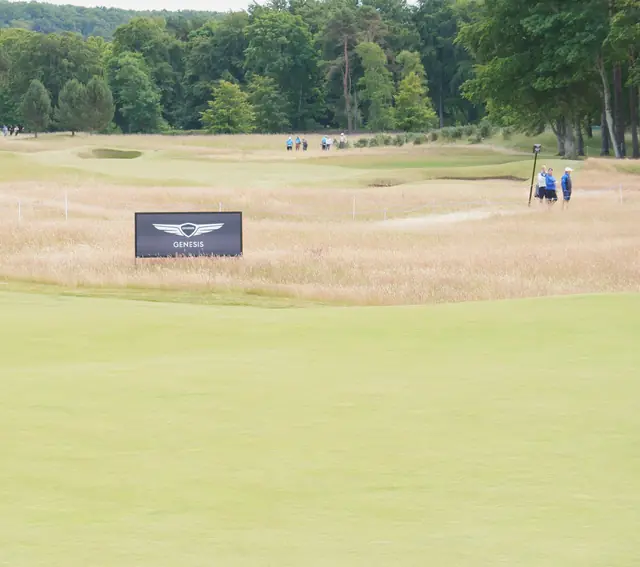

The story behind the championship
The Scottish Open has travelled from Dundee and St Andrews to Glasgow, Gleneagles, Carnoustie, Loch Lomond and the modern coastal venues that make it a natural companion to The Open. Its history explains why this national championship has become a destination in its own right: spectators can follow leading players while exploring very different parts of Scotland.
A national championship with more than one beginning
Earlier Scottish Opens were played in 1935 and 1936, with Jimmy Adams winning the second edition. The long break before the modern tournament explains why the championship has more than one beginning: the name reaches back to the pre-war game, while its continuous tour history belongs to a later period.
The modern tour history begins in 1972, when Neil Coles won the Sunbeam Electric Scottish Open at Downfield in Dundee. Graham Marsh followed him as champion at St Andrews in 1973. Those first two names establish an important point about the competition: its identity has never depended upon a permanent course. A Scottish championship could move between an inland club and the country's best-known links while retaining its national character.
The championship then disappeared from the tour calendar between 1974 and 1985. That interruption separates its first modern appearances from the sustained sequence that began in 1986. A champions list should show the missing seasons rather than suggest an unbroken annual tournament. Earlier events carrying the Scottish Open name in the 1930 s belong in the wider story, but they need to be distinguished from the European Tour competition whose official results begin in 1972.
For a visitor, these beginnings offer a useful alternative to assuming that all Scottish tournament history lies beside the sea. Downfield is part of Dundee's golf landscape; the following year's championship placed the event in St Andrews. Starting with those two locations gives the competition a broader Scottish geography than its recent East Lothian home alone might suggest.
Haggs Castle and the return in 1986
David Feherty won the revived championship at Haggs Castle in Glasgow in 1986. The return ended the long absence and began the continuous modern sequence. The choice of Haggs Castle also matters: this was a championship being rebuilt through established Scottish clubs, rather than a coastal tournament simply waiting for its familiar place before The Open.
A modern travel plan can use that distinction. Glasgow, Perthshire, Fife and East Lothian each tell part of the Scottish Open story, but they offer different kinds of golf holiday. Following the historical venues is a way to see how championship golf reached beyond the usual image of dunes, beaches and pot bunkers.
Feherty's victory is also a reminder that the roll of honour includes players whose later public profiles can overshadow their playing careers. A championship history restores the competitive achievement to its original setting: a winner, a course and a particular season, rather than a name remembered mainly from broadcasting.
Eight years at Gleneagles
The championship moved to Gleneagles in 1987 and stayed through 1994. Ian Woosnam won the first of those editions and returned to win in 1990. Barry Lane, Michael Allen, Craig Parry, Peter O'Malley, Jesper Parnevik and Carl Mason complete that Gleneagles sequence.
Those names give the period its own character. Woosnam was the repeat champion, but the intervening winners came from several different golfing countries. The event's international field was established well before its present partnership between the major tours. Scotland provided the setting; the championship drew its competitive interest from players arriving from far beyond it.
Gleneagles also makes an instructive contrast with the current tournament. Its Perthshire setting puts the Scottish Open within the history of inland Scottish championship golf. The event could be a major fixture without being played on a links course. Later moves towards coastal venues changed its relationship with The Open, but should not erase the earlier chapter.
Visitors tracing the competition can connect this period with the wider Gleneagles story, including the venue's other professional events and international team matches. The Scottish Open provides a distinct strand within that larger history. The eight champions are evidence of a sustained home, rather than a single visiting tournament.
Carnoustie and two champions in 1996
Wayne Riley won at Carnoustie in 1995, and Woosnam won there in 1996. The latter was Woosnam's third Scottish Open title. His earlier victories had come at Gleneagles, so the record spans two sharply different Scottish championship settings.
The 1996 season needs a footnote in any complete champions table. Thomas Bjørn won the Loch Lomond World Invitational that year, and the European Tour later recognised the Loch Lomond winners as Scottish Open champions. Consequently, both Woosnam's Carnoustie victory and Bjørn's Loch Lomond victory belong in the championship's recognised history.
The Tour explained the retrospective decision explicitly, referring to Woosnam as the Scottish Open champion at Carnoustie and acknowledging Bjørn's win in the same year. Readers should therefore see two separate 1996 entries, with the event names and venues identified. Compressing the year into a single winner would lose a real part of the history.
This is more than a statistical curiosity. It marks the transition between the championship's earlier travelling identity and the long Loch Lomond period. The paperwork of tournament recognition followed the competitive events; the resulting roll of honour preserves both.
The Loch Lomond years
Loch Lomond became the tournament's sustained home through 2010. The official history includes Bjørn's 1996 victory, followed by Tom Lehman in 1997, Lee Westwood in 1998 and Colin Montgomerie in 1999. Ernie Els won in 2000 and 2003; Retief Goosen won in 2001 and Eduardo Romero in 2002.
The early years at the course therefore brought together prominent champions from Europe, the United States, South Africa and Argentina. The scenery gave the event a distinctive television identity, but the strength of the winners is equally important to understanding its stature.
The later Loch Lomond champions were Thomas Levet, Tim Clark, Johan Edfors, Grégory Havret, Graeme McDowell, Martin Kaymer and Edoardo Molinari. Their victories make the period rewarding to explore because the competition did not settle into a repetitive procession of the same few names. Different players supplied the decisive week.
Molinari's 2010 win closed this chapter. The Tour's own retrospective links that season with his selection for Europe's Ryder Cup team. It places a national-open victory within the wider competitive pressures of a Ryder Cup year, when performances in Scotland could have consequences beyond the trophy presented on Sunday.
Castle Stuart changes the setting
In 2011 the tournament moved to Castle Stuart near Inverness. Luke Donald won the first edition there, followed by Jeev Milkha Singh in 2012 and Phil Mickelson in 2013. Alex Noren added another Castle Stuart victory in 2016.
The move changed the visual and sporting context of the championship. The Scottish Open now offered a coastal examination in the week before The Open, making the journey north part of a connected fortnight for players and spectators. For travellers, Inverness and the surrounding Highland landscape became part of that two-week itinerary.
Mickelson's 2013 season provides the clearest bridge between the competitions: he won the Scottish Open and then The Open at Muirfield. The two titles were separate achievements, but their proximity helped underline the appeal of a Scottish Open immediately before the major. Spectators could see a player succeed in Scotland and follow the next chapter a week later.
Castle Stuart also widened the competition's travel map. A visitor interested in the championship's history has good reason to look beyond the Central Belt and East Lothian. The northern chapter is part of the event's modern identity, not an incidental diversion.
Aberdeen, Gullane and Dundonald
Justin Rose won at Royal Aberdeen in 2014. Rickie Fowler won at Gullane in 2015, and Rafa Cabrera Bello won at Dundonald Links in 2017. Brandon Stone brought the championship back to Gullane with his victory in 2018.
These moves restored a travelling pattern after the stability of Loch Lomond, while maintaining the coastal emphasis introduced at Castle Stuart. The venues offer different landscapes and different places to stay, but all place the visitor within Scotland's wider championship-golf geography.
The sequence is especially useful when deciding how to build a golf trip. Royal Aberdeen points towards the north-east coast; Gullane brings the visitor to East Lothian; Dundonald connects the story with Ayrshire. A list of champions becomes a practical route through places that have shaped the tournament.
The changing venues also warn against treating historical scores as a simple league table of performances. Course par, weather and the layout in use affect the numbers. A winning total belongs beside its venue and year. Reading those columns together gives a fairer picture than ranking totals without context.
Renaissance and the present era
The Renaissance Club first hosted the Scottish Open in 2019, when Bernd Wiesberger won. Aaron Rai followed in 2020, defeating Tommy Fleetwood in a play-off. That 2020 edition was played: it must not be confused with championships cancelled during the pandemic.
Min Woo Lee won in 2021, Xander Schauffele in 2022, Rory McIlroy in 2023, Robert MacIntyre in 2024 and Chris Gotterup in 2025. Tom Kim won the 2026 edition with a 17-under-par total, finishing two strokes ahead of Min Woo Lee. The list shows how firmly the event now connects Scottish golf with the leading international tours.
The tournament became co-sanctioned by the DP World Tour and PGA TOUR in 2022. That change provides a clear organisational milestone within an older history. The Scottish Open had already attracted prominent international champions; the new arrangement formalised its place across both tours.
For spectators, the Renaissance period offers a stable base from which to understand the current event. For the longer historical view, it is the latest venue chapter in a competition that has repeatedly changed its home, sponsorship and position within professional golf.
Reading the champions list
The accompanying table includes every edition in the official modern Scottish Open history, with both recognised 1996 tournaments shown separately. Seasons between the first modern edition and the present in which no championship took place are marked as not held. Play-offs are distinguished from victories decided by a stroke margin.
Woosnam's three titles stand out because they cross the Gleneagles and Carnoustie periods. Els's two Loch Lomond victories mark a different kind of repeated success at a single host. Other champions provide more individual stories: first tour wins, national successes and performances immediately before The Open.
The table is most useful as a guide to those connections. Choose a year, identify the course, then follow the venue history to see what the player faced. The resulting picture is richer than a trophy count alone and gives a spectator specific moments to remember when walking the grounds today.
Visit the Scottish Open today
Start with the Scottish Open event hub for current trip planning, then explore The Renaissance Club venue guide and the relevant where-to-stay guide. East Lothian is the natural base for the present championship; the earlier hosts offer additional stops for a longer Scottish golf journey.
Our suggestion is to let the history influence one extra day of the trip. A visit to a former host, a walk through St Andrews or time in the region associated with a favourite champion makes the tournament week feel part of a larger Scottish story. Arrange any course visit through the venue's own current access information and keep championship transport planning separate from an ordinary sightseeing day.
Early champions
Early editions are listed separately from the modern tour results. The source links beside each Scottish Open History and Champions entry lead to the organiser material and independent history.
| Year | Champion | Venue | Competition | Source note | Sources |
|---|---|---|---|---|---|
| 1935 | Percy Alliss | Gleneagles (King’s) | — | Reported: independent history | Official · Cross-check |
| 1936 | Jimmy Adams | Ayr Belleisle | — | Reported in part: see sources | Official · Cross-check |
Champions and years not held
| Year | Champion | Venue or reason not held | Total | Winning margin | Sources |
|---|---|---|---|---|---|
| 1937 | Not held | No championship staged between the early editions and the 1972 revival | — | — | Official · Cross-check |
| 1938 | Not held | No championship staged between the early editions and the 1972 revival | — | — | Official · Cross-check |
| 1939 | Not held | No championship staged between the early editions and the 1972 revival | — | — | Official · Cross-check |
| 1940 | Not held | No championship staged between the early editions and the 1972 revival | — | — | Official · Cross-check |
| 1941 | Not held | No championship staged between the early editions and the 1972 revival | — | — | Official · Cross-check |
| 1942 | Not held | No championship staged between the early editions and the 1972 revival | — | — | Official · Cross-check |
| 1943 | Not held | No championship staged between the early editions and the 1972 revival | — | — | Official · Cross-check |
| 1944 | Not held | No championship staged between the early editions and the 1972 revival | — | — | Official · Cross-check |
| 1945 | Not held | No championship staged between the early editions and the 1972 revival | — | — | Official · Cross-check |
| 1946 | Not held | No championship staged between the early editions and the 1972 revival | — | — | Official · Cross-check |
| 1947 | Not held | No championship staged between the early editions and the 1972 revival | — | — | Official · Cross-check |
| 1948 | Not held | No championship staged between the early editions and the 1972 revival | — | — | Official · Cross-check |
| 1949 | Not held | No championship staged between the early editions and the 1972 revival | — | — | Official · Cross-check |
| 1950 | Not held | No championship staged between the early editions and the 1972 revival | — | — | Official · Cross-check |
| 1951 | Not held | No championship staged between the early editions and the 1972 revival | — | — | Official · Cross-check |
| 1952 | Not held | No championship staged between the early editions and the 1972 revival | — | — | Official · Cross-check |
| 1953 | Not held | No championship staged between the early editions and the 1972 revival | — | — | Official · Cross-check |
| 1954 | Not held | No championship staged between the early editions and the 1972 revival | — | — | Official · Cross-check |
| 1955 | Not held | No championship staged between the early editions and the 1972 revival | — | — | Official · Cross-check |
| 1956 | Not held | No championship staged between the early editions and the 1972 revival | — | — | Official · Cross-check |
| 1957 | Not held | No championship staged between the early editions and the 1972 revival | — | — | Official · Cross-check |
| 1958 | Not held | No championship staged between the early editions and the 1972 revival | — | — | Official · Cross-check |
| 1959 | Not held | No championship staged between the early editions and the 1972 revival | — | — | Official · Cross-check |
| 1960 | Not held | No championship staged between the early editions and the 1972 revival | — | — | Official · Cross-check |
| 1961 | Not held | No championship staged between the early editions and the 1972 revival | — | — | Official · Cross-check |
| 1962 | Not held | No championship staged between the early editions and the 1972 revival | — | — | Official · Cross-check |
| 1963 | Not held | No championship staged between the early editions and the 1972 revival | — | — | Official · Cross-check |
| 1964 | Not held | No championship staged between the early editions and the 1972 revival | — | — | Official · Cross-check |
| 1965 | Not held | No championship staged between the early editions and the 1972 revival | — | — | Official · Cross-check |
| 1966 | Not held | No championship staged between the early editions and the 1972 revival | — | — | Official · Cross-check |
| 1967 | Not held | No championship staged between the early editions and the 1972 revival | — | — | Official · Cross-check |
| 1968 | Not held | No championship staged between the early editions and the 1972 revival | — | — | Official · Cross-check |
| 1969 | Not held | No championship staged between the early editions and the 1972 revival | — | — | Official · Cross-check |
| 1970 | Not held | No championship staged between the early editions and the 1972 revival | — | — | Official · Cross-check |
| 1971 | Not held | No championship staged between the early editions and the 1972 revival | — | — | Official · Cross-check |
| 1972 | Neil Coles | Downfield GC, Dundee, Scotland | 283 | Play-off | Official · Cross-check |
| 1973 | Graham Marsh | St. Andrews, St Andrews, Scotland | 286 | 6 strokes | Official · Cross-check |
| 1974 | Not held | Tournament absent from the tour calendar until the 1986 revival | — | — | Official · Cross-check |
| 1975 | Not held | Tournament absent from the tour calendar until the 1986 revival | — | — | Official · Cross-check |
| 1976 | Not held | Tournament absent from the tour calendar until the 1986 revival | — | — | Official · Cross-check |
| 1977 | Not held | Tournament absent from the tour calendar until the 1986 revival | — | — | Official · Cross-check |
| 1978 | Not held | Tournament absent from the tour calendar until the 1986 revival | — | — | Official · Cross-check |
| 1979 | Not held | Tournament absent from the tour calendar until the 1986 revival | — | — | Official · Cross-check |
| 1980 | Not held | Tournament absent from the tour calendar until the 1986 revival | — | — | Official · Cross-check |
| 1981 | Not held | Tournament absent from the tour calendar until the 1986 revival | — | — | Official · Cross-check |
| 1982 | Not held | Tournament absent from the tour calendar until the 1986 revival | — | — | Official · Cross-check |
| 1983 | Not held | Tournament absent from the tour calendar until the 1986 revival | — | — | Official · Cross-check |
| 1984 | Not held | Tournament absent from the tour calendar until the 1986 revival | — | — | Official · Cross-check |
| 1985 | Not held | Tournament absent from the tour calendar until the 1986 revival | — | — | Official · Cross-check |
| 1986 | David Feherty | Haggs Castle GC, Glasgow, Scotland | 270 | Play-off | Official · Cross-check |
| 1987 | Ian Woosnam | The Gleneagles Hotel, Perthshire, Scotland | 264 | 7 strokes | Official · Cross-check |
| 1988 | Barry Lane | The Gleneagles Hotel, Perthshire, Scotland | 271 | 3 strokes | Official · Cross-check |
| 1989 | Michael Allen | The Gleneagles Hotel, Perthshire, Scotland | 272 | 2 strokes | Official · Cross-check |
| 1990 | Ian Woosnam | The Gleneagles Hotel, Perthshire, Scotland | 269 | 4 strokes | Official · Cross-check |
| 1991 | Craig Parry | The Gleneagles Hotel, Perthshire, Scotland | 268 | 1 stroke | Official · Cross-check |
| 1992 | Peter O'Malley | The Gleneagles Hotel, Perthshire, Scotland | 262 | 2 strokes | Official · Cross-check |
| 1993 | Jesper Parnevik | The Gleneagles Hotel, Perthshire, Scotland | 271 | 5 strokes | Official · Cross-check |
| 1994 | Carl Mason | The Gleneagles Hotel, Perthshire, Scotland | 265 | 1 stroke | Official · Cross-check |
| 1995 | Wayne Riley | Carnoustie, Angus, Scotland | 276 | 2 strokes | Official · Cross-check |
| 1996 | Ian Woosnam | Carnoustie, Angus, Scotland | 289 | 4 strokes | Official · Cross-check |
| 1996 | Thomas Bjørn | Loch Lomond GC, Glasgow, Scotland | 277 | 1 stroke | Official · Cross-check |
| 1997 | Tom Lehman | Loch Lomond GC, Glasgow, Scotland | 265 | 5 strokes | Official · Cross-check |
| 1998 | Lee Westwood | Loch Lomond GC, Glasgow, Scotland | 276 | 4 strokes | Official · Cross-check |
| 1999 | Colin Montgomerie | Loch Lomond GC, Glasgow, Scotland | 268 | 3 strokes | Official · Cross-check |
| 2000 | Ernie Els | Loch Lomond GC, Glasgow, Scotland | 273 | 1 stroke | Official · Cross-check |
| 2001 | Retief Goosen | Loch Lomond GC, Glasgow, Scotland | 268 | 3 strokes | Official · Cross-check |
| 2002 | Eduardo Romero | Loch Lomond GC, Glasgow, Scotland | 273 | Play-off | Official · Cross-check |
| 2003 | Ernie Els | Loch Lomond GC, Glasgow, Scotland | 267 | 5 strokes | Official · Cross-check |
| 2004 | Thomas Levet | Loch Lomond GC, Glasgow, Scotland | 269 | 1 stroke | Official · Cross-check |
| 2005 | Tim Clark | Loch Lomond GC, Glasgow, Scotland | 265 | 2 strokes | Official · Cross-check |
| 2006 | Johan Edfors | Loch Lomond GC, Glasgow, Scotland | 271 | 2 strokes | Official · Cross-check |
| 2007 | Grégory Havret | Loch Lomond GC, Glasgow, Scotland | 270 | Play-off | Official · Cross-check |
| 2008 | Graeme Mcdowell | Loch Lomond GC, Glasgow, Scotland | 271 | 2 strokes | Official · Cross-check |
| 2009 | Martin Kaymer | Loch Lomond GC, Glasgow, Scotland | 269 | 2 strokes | Official · Cross-check |
| 2010 | Edoardo Molinari | Loch Lomond GC, Glasgow, Scotland | 272 | 3 strokes | Official · Cross-check |
| 2011 | Luke Donald | Castle Stuart Golf Links, Inverness, Scotland | 197 | 4 strokes | Official · Cross-check |
| 2012 | Jeev Milkha Singh | Castle Stuart Golf Links, Inverness, Scotland | 271 | Play-off | Official · Cross-check |
| 2013 | Phil Mickelson | Castle Stuart Golf Links, Inverness, Scotland | 271 | Play-off | Official · Cross-check |
| 2014 | Justin Rose | Royal Aberdeen, Aberdeen, Scotland | 268 | 2 strokes | Official · Cross-check |
| 2015 | Rickie Fowler | Gullane GC, Gullane, East Lothian, Scotland | 268 | 1 stroke | Official · Cross-check |
| 2016 | Alex Noren | Castle Stuart Golf Links, Inverness, Scotland | 274 | 1 stroke | Official · Cross-check |
| 2017 | Rafa Cabrera Bello | Dundonald Links, Troon, Ayrshire, Scotland | 275 | Play-off | Official · Cross-check |
| 2018 | Brandon Stone | Gullane GC, Gullane, East Lothian, Scotland | 260 | 4 strokes | Official · Cross-check |
| 2019 | Bernd Wiesberger | The Renaissance Club, North Berwick, Scotland | 262 | Play-off | Official · Cross-check |
| 2020 | Aaron Rai | The Renaissance Club, North Berwick, Scotland | 273 | Play-off | Official · Cross-check |
| 2021 | Min Woo Lee | The Renaissance Club, North Berwick, Scotland | 266 | Play-off | Official · Cross-check |
| 2022 | Xander Schauffele | The Renaissance Club, North Berwick, Scotland | 273 | 1 stroke | Official · Cross-check |
| 2023 | Rory Mcilroy | The Renaissance Club, North Berwick, Scotland | 265 | 1 stroke | Official · Cross-check |
| 2024 | Robert Macintyre | The Renaissance Club, North Berwick, Scotland | 262 | 1 stroke | Official · Cross-check |
| 2025 | Chris Gotterup | The Renaissance Club, North Berwick, Scotland | 265 | 2 strokes | Official · Cross-check |
| 2026 | Tom Kim | The Renaissance Club, North Berwick, Scotland | 263 | 2 strokes | Official · Cross-check |
The two events in 1996
The 1996 entries include Ian Woosnam’s Scottish Open at Carnoustie and Thomas Bjørn’s Loch Lomond tournament, which the tour’s retrospective Scottish Open history also includes. They were separate competitions.
The 1935 winner and venue, and the 1936 venue, remain reported from the linked independent histories; primary confirmation of those details has not been recovered.
Sources and useful official links
Useful reading for your visit
Visit today
- The Renaissance Club visitor guide
- Genesis Scottish Open 2027 at The Renaissance Club
- Where to stay for the Scottish Open: North Berwick and East Lothian
Some links earn us a small commission at no extra cost to you. Affiliate disclosure.