
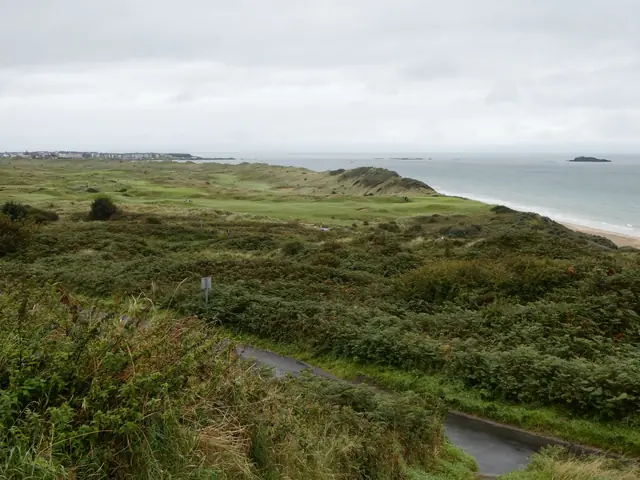

The story behind the championship
Shane Lowry's victory at Royal Portrush brought together a returning championship, a course on a major stage again and a player winning his first major. The Open had not been held in Northern Ireland since 1951. In July 2019, Lowry completed rounds of 67, 67, 63 and 72 for 269, finishing six strokes ahead of Tommy Fleetwood.
The final margin can make the week look simpler than it was. Lowry first had to establish his position, then separate himself from the field with a remarkable Saturday round, and finally preserve the advantage in worsening weather. Sunday included an opening bogey, a recovery, further dropped shots and renewed pressure from his playing partner. The champion's walk up the last was the end of that process, not evidence that the result had been certain from the first tee. Official edition record.
The Open returns after 68 years
Royal Portrush had hosted The Open in 1951, when Max Faulkner won. The 2019 return ended a 68-year interval and brought the championship back to the County Antrim coast. The event's history there was therefore both old and newly active: this was a previous Open venue welcoming a modern championship after a long absence.
Lowry was from County Offaly in the Republic of Ireland, rather than a player from Northern Ireland. That distinction can be stated without diminishing the support he received across the island. The organiser's account identifies him accurately and describes the strength of the crowd behind him. The setting made the victory especially resonant, while the sporting result still depended on his completed score against an international field. Official Royal Portrush championship history.
A contender with a previous major disappointment
Lowry had won the Irish Open as an amateur in 2009 and arrived at Portrush with further professional success behind him. He had also led the 2016 US Open by four strokes after 54 holes before losing to Dustin Johnson. That earlier event became part of the background to his final day at Portrush, where he again held a four-stroke advantage.
The parallel was real, but it was not a prediction. Different courses, opponents and conditions meant the earlier result could not decide the later championship. A careful history can explain why the comparison was being made without treating Lowry's private state of mind as something a writer can reconstruct. The verified facts were an earlier lost lead and a new opportunity to convert another one. What followed at Portrush would be determined by the golf played there. Official Lowry profile; organiser's final-day retrospective.
Two 67s create the platform
Lowry opened with consecutive 67s and shared the halfway lead with J. B. Holmes. The rounds put him in a strong position without yet giving him the clear advantage associated with the final result. The championship was still open to several contenders, and Saturday would be the point at which his week changed shape.
That starting position matters when remembering the 63. The extraordinary round did not arrive in isolation from the tournament: it built on two low scores already returned. Equally, the first two days had not made the third unnecessary. Lowry had to keep improving his position against other players who were also scoring well. The four-round total eventually combined three days under par with a more difficult final round. Understanding that mixture gives the winning margin a history rather than treating it as one uninterrupted charge. Official championship summary.
Saturday's eight birdies
The third-round 63 contained eight birdies and no bogeys. Lowry and Fleetwood remained close for much of the afternoon, but Lowry's closing stretch changed the leaderboard. Birdies at the 15th, 16th and 17th helped create a four-stroke lead with one round remaining.
The 16th, Calamity Corner, gave the sequence a particularly recognisable setting. Lowry's tee shot finished close enough for another birdie opportunity, which he converted. His round ended with a chance to make 62 at the 18th, but the putt missed and the score remained 63. That does not make the completed round less exceptional. It establishes the actual achievement: a bogey-free course record on the championship layout, a total of 197 through three rounds and a substantial lead earned before Sunday's weather arrived. Official third-round report.
Why the layout qualification matters
The organiser describes the 63 as a record for the new Portrush layout. That wording should remain attached to the claim. A course with a long history can undergo changes that make a modern championship record different from a blanket record covering every previous configuration, tee and competition.
The achievement can also be placed in its 2019 context. Lowry had a putt to equal the then major-championship low round of 62, set by Branden Grace at Royal Birkdale in 2017. He did not hole it. The history therefore records the 63 he made, rather than a score that was nearly achieved. That precision is useful for visitors interested in course records: the named championship, date and layout are part of the record, not optional details added after the number. Official review of Portrush's 2019 low rounds.
The first hole offers an opening
Lowry began Sunday four strokes ahead of Fleetwood. At the first, he needed a bogey putt while Fleetwood had a birdie chance. A three-stroke swing was possible, but Fleetwood missed and Lowry holed. The lead was reduced by one, to three, rather than disappearing almost entirely.
It was an early example of how a final margin can conceal moments when the balance might have shifted. The actual outcome, however, was a bogey against a par, not the more dramatic combination of scores that had briefly been possible. Fleetwood's later account and the organiser's report preserve that distinction. Lowry still had a lead from which to work, and the next holes gave him opportunities to regain control. The final day had begun with a test, but it had not yet acquired its eventual pattern. Official account of Fleetwood's final round.
Birdies, then further dropped shots
Lowry birdied the fourth, fifth and seventh, reaching 18 under par. He then dropped shots as conditions became more difficult, allowing Fleetwood to reduce the gap again. By the time six holes remained, the lead was four: still substantial, but not an invitation to stop concentrating on the next shot.
The 14th produced another important comparison of scores. Lowry made bogey, but Fleetwood took a double bogey, so the leader gained ground despite dropping a stroke himself. That is a useful illustration of championship golf in poor weather. The number on an individual scorecard matters, but its effect on the title also depends on what the opponents make. Lowry's round was not flawless; it was sufficiently controlled in relation to the players trying to catch him. Official final-round report.
The birdie at the 15th
A birdie at the 15th strengthened Lowry's advantage and gave the final holes a different character. The championship still had to be completed, but the nearest challenge had weakened. Lowry eventually signed for 72, one over par, and a winning total of 269, 15 under.
Fleetwood finished second on 275. Tony Finau was third, with Lee Westwood and Brooks Koepka sharing fourth. The final leaderboard shows that Lowry had separated himself from more than one pursuer: it was not simply a contest in which two players were tied until the last few putts. Saturday created the large advantage; Sunday maintained enough of it and ultimately increased the margin over the closest rival. Official result and leaderboard; organiser's statistical review.
A first major and a lasting Portrush memory
Lowry's first major came ten years after his amateur Irish Open victory. It also gave the returning Open a champion whose success connected strongly with the galleries on the island. Independent Irish reporting records both the difficult final-day conditions and the emphatic six-stroke result, providing a check on the organiser's account.
The finish belongs to Portrush's history without replacing its earlier championship. Faulkner's 1951 win and Lowry's 2019 success describe two different returns from the same course's wider record. Later editions add further chapters. The purpose of remembering this week is not to promise that every future visit will recreate its atmosphere. It is to understand what happened, why the third round was decisive and how the final round turned a lead into a completed victory. Independent contemporary report.
Connect the story with a visit
Open the Royal Portrush course history, then the venue and accommodation guides for the north coast. The Open hub covers the next championship's planning information. Check current routes and access rather than assuming the 2019 spectator arrangements remain in use.
Sources and useful official links
- Confirmed: Official edition record
- Confirmed: Official Royal Portrush championship history
- Confirmed: Official Lowry profile
- Confirmed: organiser's final-day retrospective
- Confirmed: Official championship summary
- Confirmed: Official third-round report
- Confirmed: Official review of Portrush's 2019 low rounds
- Confirmed: Official account of Fleetwood's final round
- Confirmed: Official final-round report
- Confirmed: Official result and leaderboard
- Confirmed: organiser's statistical review
- Reported: Independent contemporary report
Useful reading for your visit
Visit today
- Royal Portrush visitor guide
- The Open 2027 at St Andrews
- Where to stay for Portrush and the Causeway Coast
Some links earn us a small commission at no extra cost to you. Affiliate disclosure.