

The story behind the championship
Jean van de Velde reached Carnoustie's final tee with a three-stroke lead in the 1999 Open. A double-bogey six would have been enough to win. He took seven, and the championship went to a four-hole play-off with Paul Lawrie and Justin Leonard. Lawrie won that play-off by three strokes.
The sequence is famous, but it is easy to tell it incompletely. Van de Velde's last hole did not itself award the Claret Jug to Lawrie. It created a tie which still had to be resolved by further golf. Lawrie had already produced a final-round 67 and then finished the play-off with consecutive birdies. Carnoustie 1999 contains both an extraordinary loss of a lead and an exceptional winning performance. Neither becomes clearer by removing the other. Official championship record.
A championship returns to Carnoustie
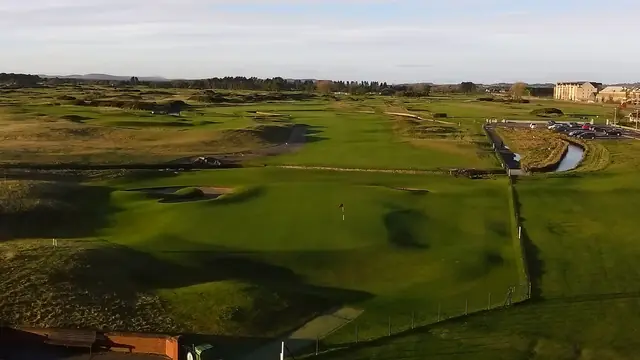
The Open had last been played at Carnoustie in 1975, when Tom Watson won. Its return after 24 years put the Championship Course back at the centre of the game. The 1999 event became closely associated with its difficult conditions and, above all, with the Barry Burn crossing the closing hole.
The burn was not a theatrical obstacle added to create a television moment. It was part of the course the players had to negotiate. The events of the final round showed how the same hole could produce different kinds of decision and recovery. Van de Velde, Leonard and Lawrie each had to play it under pressure, but their circumstances were not identical. Carnoustie's own history treats the championship as a landmark because of that dramatic finish and the Scottish winner it produced. Host's past-Opens history.
The leader and the distant challenger
Van de Velde's first three rounds were 75, 68 and 70. Lawrie's were 73, 74 and 76. The Frenchman had therefore taken 213 strokes, the Scot 223: ten strokes separated them with one round remaining. The figures establish the size of Lawrie's recovery without requiring a claim that he expected to win when Sunday began.
Lawrie had entered through final qualifying at Downfield. The organiser's profile records his qualifying route and identifies him as 241st in the world at the championship. Those details explain why his eventual victory was unexpected, but they should not be used to dismiss the quality of the golf he played. A qualifier who reaches the starting field competes for the same title as everyone else. His final round and play-off were part of the championship, not an alternative competition. Official Lawrie profile.
A 67 creates a target
Lawrie returned 67 on the final day, bringing his total to 290, six over par. It was a substantial improvement on his earlier rounds and put a completed score on the leaderboard while Van de Velde was still on the course. The total did not guarantee a play-off: the leader still had enough room to finish in front.
That distinction helps explain the order of events. Lawrie did not make up ten strokes through the play-off; he erased the overnight difference during regulation play, through his own low round and the leader's higher score. Once the players were tied after 72 holes, the additional contest began from that tie. Describing the achievement accurately preserves both parts of his victory. His comeback created the opportunity, and the extra holes decided whether he would become champion. Official account of Lawrie's winning performance.
The second shot hits the grandstand
Van de Velde's drive on the 18th was wayward, but his situation remained recoverable. His second shot struck a railing on the greenside grandstand and rebounded into thick rough. The unexpected bounce changed the lie from which he had to play the next stroke.
It is tempting to turn the moment into a simple lesson in what club he should have selected. The documented sequence is more useful than a confident claim about an alternative result. Different choices might have produced different outcomes, but they were not played. The actual championship proceeded from a difficult position in the rough, followed by a pitch into the Barry Burn. That was the point at which the leader's margin and his remaining strokes came under immediate pressure. Organiser's detailed retrospective.
The scene in the Barry Burn
Van de Velde removed his shoes and socks and went into the burn to assess whether he could play the ball. In the organiser's later documentary account, he explained that he could initially see it on sand with part of it above the water. As he examined the situation, the water rose and the prospect of playing changed.
He ultimately took a penalty drop rather than attempting the stroke from the burn. The distinction matters because the image of him standing in the water is so memorable that it can displace what actually followed. He did not complete the hole by hitting from that position. The championship continued after the drop, with another shot still required towards the green. This account follows the player's published explanation of his decision, without supplying unrecorded thoughts or invented dialogue. Official documentary account.
A bunker shot and a necessary putt
His next stroke found a bunker. From there, Van de Velde played out and holed the putt needed for seven. That final up-and-down is a significant part of the story. It was not enough to win in regulation, but it was enough to remain in the championship.
A worse finish would have left him outside the tie. Instead, Lawrie, Leonard and Van de Velde completed 72 holes on the same total. The word collapse can describe the loss of the lead, but it should not conceal the successful recovery that secured a place in extra holes. The round had become a final-hole crisis, yet the player still completed the two strokes that kept his chance alive. The historical result includes the tie as well as the later defeat. Official championship summary.
Leonard's different route into the play-off
Leonard, the 1997 Open winner, had also encountered the burn on the 18th. Believing he needed a birdie to challenge Van de Velde, he played an aggressive second shot which found the water. He recovered a bogey to finish level with Lawrie, initially believing his opportunity had gone.
Van de Velde's later seven changed that position. Leonard was back in contention, but his final hole had already shaped the score with which he entered the play-off. His experience prevents the championship from becoming a two-person story. Three golfers reached the same regulation total through different final-round sequences, and all three then faced the additional contest. The organiser's documentary includes their recollections separately, making clear that the famous last-hole scene was not the only experience of pressure that afternoon. Official three-player retrospective.
Lawrie completes the victory
The four-hole play-off began at the 15th. Lawrie reached its final hole one stroke ahead of the other two, having birdied the 17th. He then drove successfully on the 18th and played a four-iron approach to about four feet. The birdie putt completed a second successive birdie and a three-stroke play-off victory.
That approach is the championship's winning stroke sequence, even if the earlier images in the burn remain better known. Lawrie had to play a demanding hole while protecting a narrow advantage, with the title still undecided. He did so through positive execution rather than receiving the trophy automatically from another player's difficulty. A balanced account can recognise Van de Velde's anguish and Lawrie's achievement at the same time. The final scores belong to Lawrie; the reason extra holes were needed belongs to the whole afternoon. Official account of the decisive approach.
What the record says
Lawrie became the first Scottish-born Open winner on Scottish soil since Tommy Armour in 1931. His ten-stroke final-round recovery remains a central part of the championship's record. The winning total is 290, and the method of victory is a play-off, not a three-stroke regulation margin.
Some later summaries contain numerical errors: a Sky Sports retrospective describes Lawrie's final round as 66, whereas the official result and the organiser's profile give 67. The official score is used here. Preserving the source difference is preferable to repeating a dramatic account without checking its arithmetic. Official Lawrie profile; independent retrospective with the noted discrepancy.
Connect the story with a visit
The Carnoustie course history places 1999 alongside its other Opens. Follow it with the venue and accommodation guides for a current visit, or use The Open hub for the next championship trip. The burn and closing holes have historical significance, but present access and tournament routes need their own checks.
Sources and useful official links
Useful reading for your visit
Visit today
Some links earn us a small commission at no extra cost to you. Affiliate disclosure.